Genesis of “The Cosmic Tree of Life” A High Resolution Digital Painting by Roger Ferragallo
Introduction
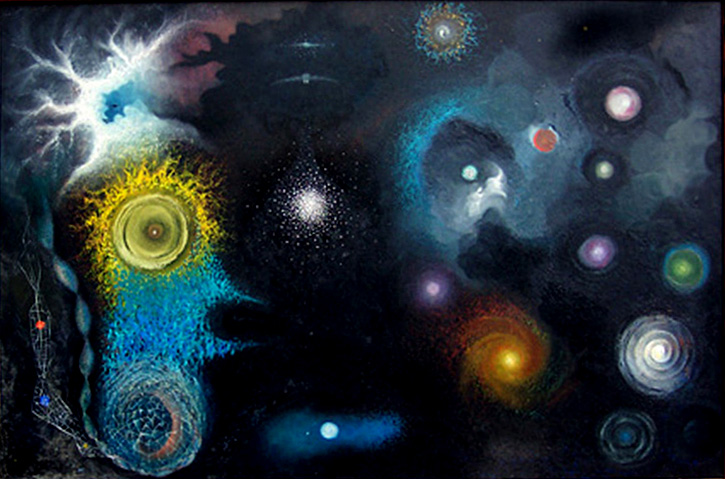
Birth in Space, Oil Crayon on Wood Panel, 20″ × 30″, 1961–62.
Birth in Space, created in 1962, was my earliest comprehensive cosmic painting, created when I was celebrating the birth of my first daughter. I gathered oil crayons, rendering them on a wood panel, to unleash thematic ideas that had been percolating in me during the 1950s about a bio-cosmic universe. Birth in Space captures a surreal conception of interstellar cosmic forms and appearances that unwind with life and fetus in a universe friendly to conscious existence. At the time, I was caught up with the fine-tuned fundamental constants of the universe that underlie the golden ratio and fractal recursive patterns in nature at all scales—from helical life forms to spiral galaxies. This would deepen my philosophic cosmic outlook of a new subject matter driven by anthropic ideas that set forth a carbon-based universe so finely tuned for life that conscious beings on our planet may well have been inevitable. These philosophical ideas only grew stronger during the 1960s and 70s, fed by visuals and data that began appearing from all science quarters: quantum to quasar.
The Anthropic Principle
In the 1950s, I had also been influenced by astronomer Fred Hoyle (1915–2001) who invoked the “Anthropic Principle,” a concept actually named later in 1972. Anthropic ideas come in several humanistic flavors that give reason to believe life had to emerge because beings like us are here as conscious observers. Hoyle also believed that the cosmic pervasiveness of carbon-based life-forms on our planet were seeded by comets and asteroids. Astrobiology today vindicates Hoyle because we observe hundreds of elemental compounds permeating interstellar space that are products of supernovae. It has been proven comets and asteroids are known to carry organic molecules and other organic materials, together with water.
Hoyle’s greatest scientific achievement was discovering nucleosynthesis, the process that happens inside stars to create most of the elements lighter than iron, and that which happens via supernovae to create all the elements heavier than iron. Supernovae are also responsible for distributing the elements throughout interstellar space. Hoyle vigorously fostered a steady state universe rather than one born from a single explosion 14 billion years ago. He went on to strongly put down advocates of an instant creation by derisively coining their explosion theory a “Big Bang.” He fought against the Big Bang theory for the remainder of his life.
The Advent of Computers and the World Wide Web, 1980–98
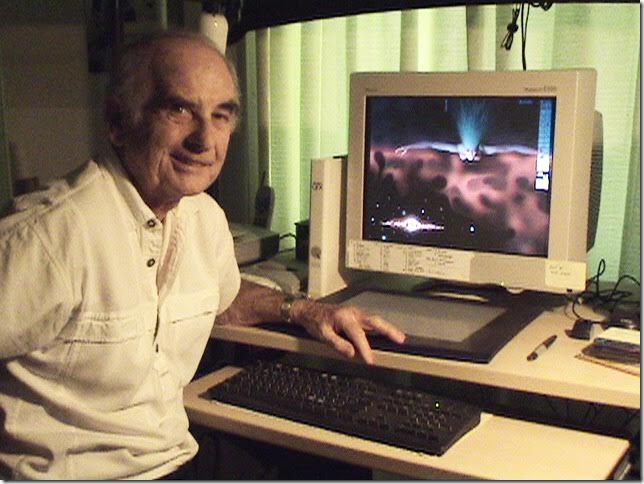
Roger Ferragallo, 1998
The 1980s saw the advent of the computer which re-ignited my longing to create a body of cosmic paintings using the art of light. It was a timely period where powerful desktop computers came in a flood to the marketplace with fast evolving paint software providing 16 million colors and a variety of tools facilitated the creation of image and form. Ink-jet Iris printers began appearing in the late 1980s that could print museum quality fine art to large canvas and paper substrates. By the mid 1990s, cathode ray monitors grew from 17 to 21 inches.
It was a time like no other, with the world wide web, beginning about 1991, roaring ahead to become the new global reality. Surely it was an electrifying time to be a painter whose cosmic dream, for more than a half century, was to create a body of cosmic works with photonic light. The computer revolution was a breathtaking time and it all happened with exponential rapidity. In 1992, I retired from a long career as an educator. That freed me to embrace my long sought dream to create a body of cosmic paintings using the medium of light. The learning curve with a pre-Windows MS-DOS operating system was daunting, but my paintings soared with the times.
At the start of the world wide web, I sought expert technical help from my niece in Germany, Caitlyn Meeks Ferragallo, now a VR specialist and technologist. Caitlyn facilitated my initial connection to the web which opened global contact and research possibilities invaluable to my cosmic work. It was an unimaginable technological era that made it possible to paint with emissive cathode light my cosmic luminal works throughout the period 1980–1998 and beyond. At the time, I had this to say:
Having all but abandoned traditional pigment, dye and ink, I find myself dazzled by a computer digital medium that allows me to paint with electrons streaming in rainbows of infinite light in a space as alive as the atmosphere itself. The affordable computer with its growing body of software tools is unprecedented, because together, they form a light speed synaptic medium which allows one to create, modify, change, store, capture, scan, and infinitely model in real-time whatever the mind can conjure. I can think of no medium, past or present, that coalesces so many powerful artistic tools within arms’ reach. Roger Ferragallo, 1998
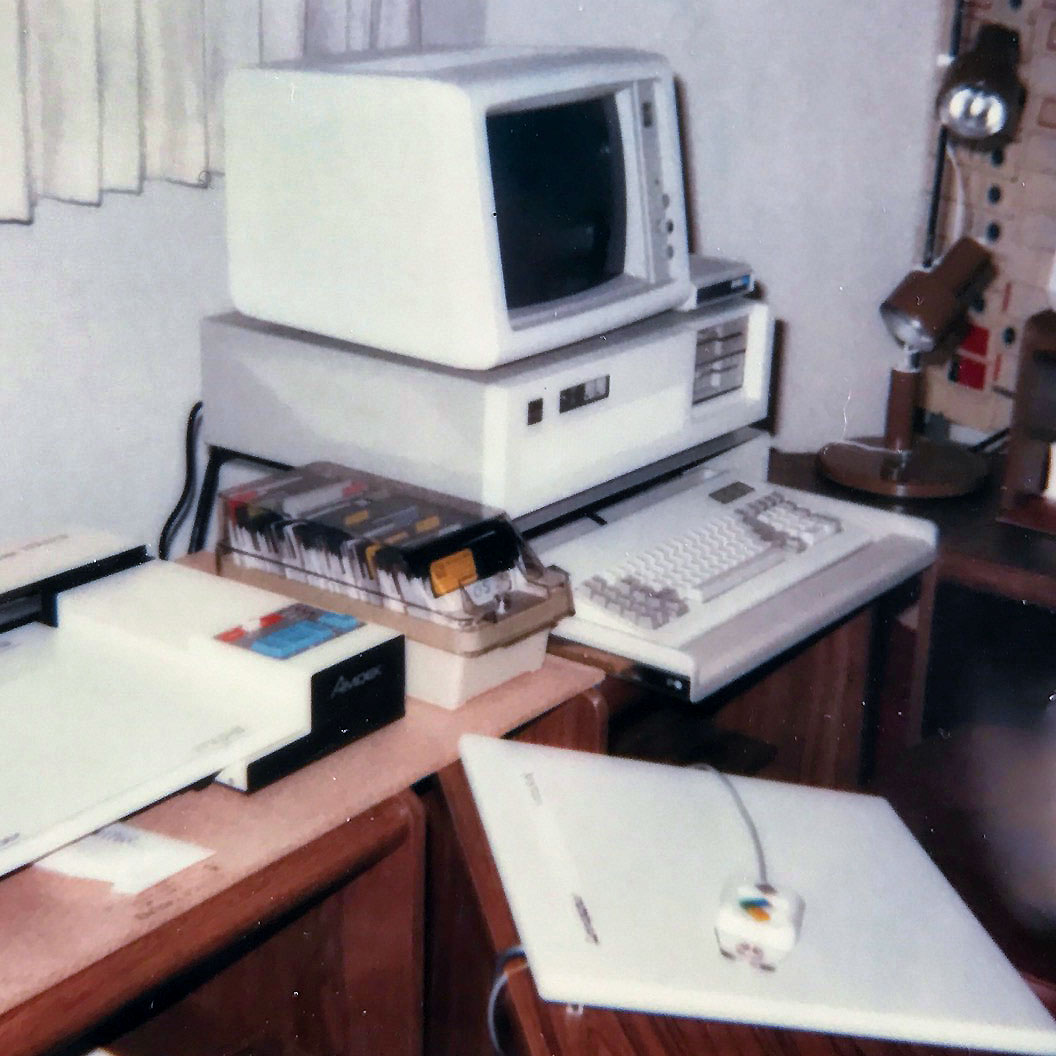
MS-DOS OS, 1985
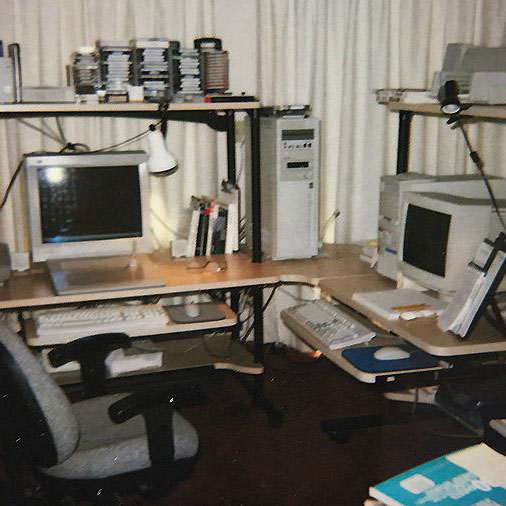
Windows OS, 1992–1999
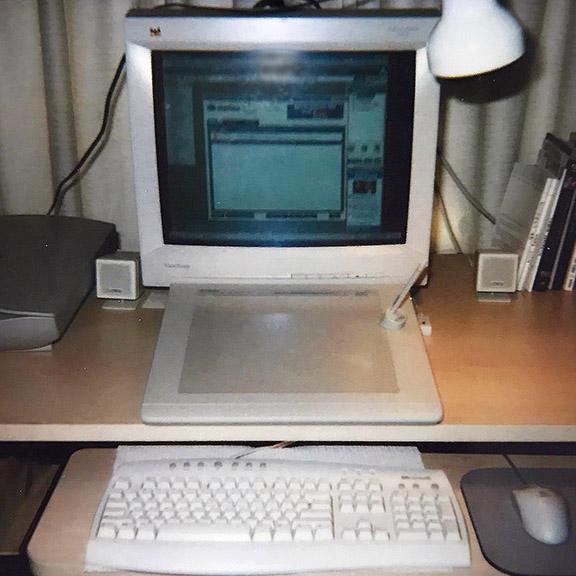
Windows OS, 1998–2000
The tools I currently employ to create my light paintings are a 486/Pentium PC linked to a Video Camera, Printer, Modem, Syquest 88 Drive, HP Flat Bed Scanner, CD/ROM Drive, 21″ Mitsubishi Monitor, 2 Gig Hard Drive and 64 Megs of Ram. My system also utilizes a Targa+64 Graphics Video Capture Board, SVGA Diamond Stealth 64 Board and WACOM 12×12 tablet with pressure sensitive cordless stylus. I principally work with three software programs: Ron Scott’s Hi Res QFX for painting, AT&T’s Rio for two dimensional graphic design and Crystal Topaz for three dimensional construction. Roger Ferragallo, 1995
The Digital Era Begins
“I Paint With Light”
Sixty Stereoscopic Digital Cosmic Paintings,
1986–1995
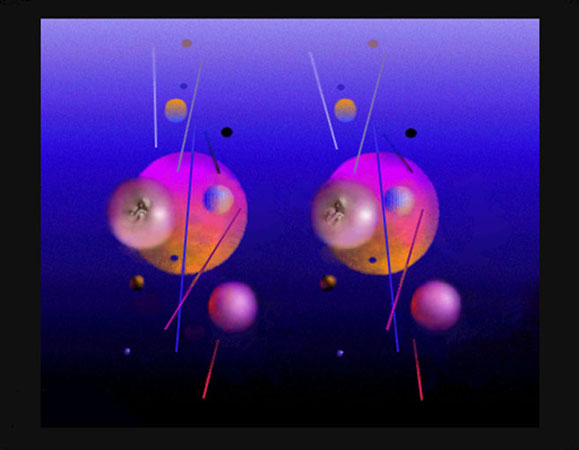
Moon Child, 1993
My first digital works began in the mid 1980s with the advent of desktop PC computers together with their large light screens, software tools, and wide color palettes. After a learning period with the daunting MS-DOS language, the appearance of “True Image-Targa Tips” software tools and its brilliant color palette made it possible to proceed with my first ‘light’ stereoscopic paintings.
Why did I choose Stereoscopic Space?
This choice was influenced by choices made in the prior decade of the 1970s. In 1972, I launched a series of unique, very large (historic) stereoscopic acrylic canvases that flourished until about the time computers began appearing. The acrylic works required "Cross-eye Free-vision” real-time viewing, which allowed viewing the painting in 3D without glasses. With the advent of computers, the digital medium set the stage for me to opportunely paint with light my first digital cosmic works (1986–96) within the reality of 3D stereoscopic space. The stereo-space methodology is amply described and illustrated in my published “Stereo Manifesto” in 1972 and my stereo painting article in the Leonardo International Journal “On Stereoscopic Painting” in 1974.
Computers provided a revolutionary new medium in the 1980s that stunned me. I immediately deemed them ‘light generators’ because of my deep interest in the art of light during my studies at the School of the Art Institute of Chicago (1948–53). What made this cosmic series possible was the appearance of the desktop computer and digital software designed for artists. Most significant was Truevision’s introduction of the Targa Videographics Card, in 1987, that launched a fully fleshed paint program called Targa-tips. It supported 24-bit color before it was available in the TIFF format. This early software provided impressive luminal paint and drawing tools to create a variety of rudimentary geometric lines, planes, circles, etc., that could be shaped, modified, and fashioned at will, as they appeared in 3D space on my monitor screen. Fortunately, the original digital mouse tool had morphed into a hand held stylus, thanks to Apple in 1979 and Wacom’s cordless in 1984. These styluses acted as both pen and brush along with a color ‘light’ palette arrayed to satisfy my joy of painting my cosmic themes with light. Thus, I proceeded with my series of sixty stereoscopic cosmic paintings.
The entire series of sixty stereoscopic works were done without mathematics or algorithms. The light paintings with their 3D effects, were produced by maneuvering by hand, dual ‘right-left’ constructed and painted visual objects, viewed directly on my monitor screen with fixated naked eye, cross-sight free-vision. With stylus in hand, I was able to dynamically move, position, and pose objects in deep 3D space with exacting precision. Here was an enchanting newfound aesthetic experience that achieved a certain spatial magic by virtually transforming a small 14″ monitor screen into the larger realm of infinite space. It was memorable, at the start, as if my cosmic themes were emerging from the dark mystique of interstellar space itself. This unique series of stereoscopic works gave voice to the awe and wonder I felt throughout the period (1986–95).
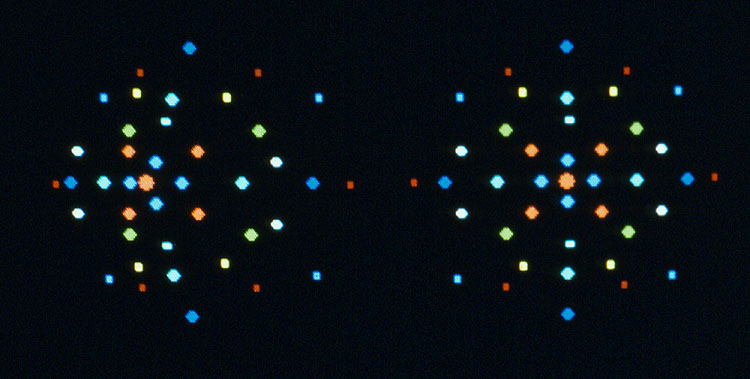
Diamond Crystal, 1986
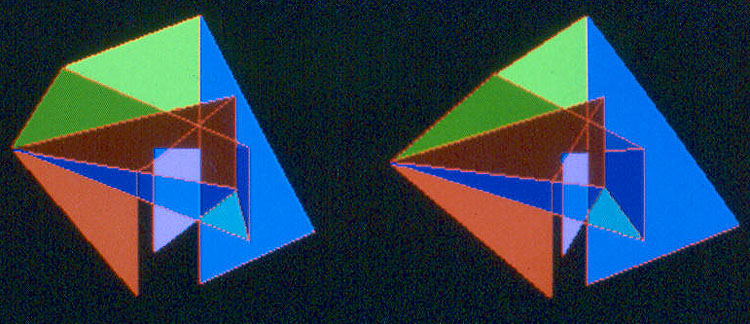
Morphed Spatial Planes, 1986
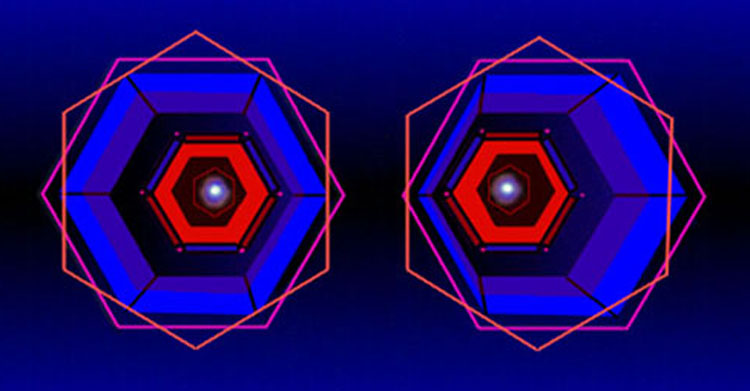
Pearl Star, 1991
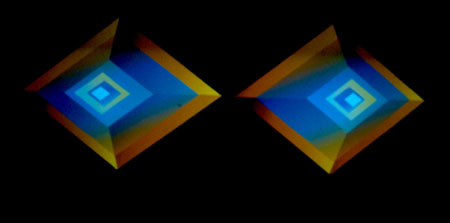
Pyramidal Force, 1988
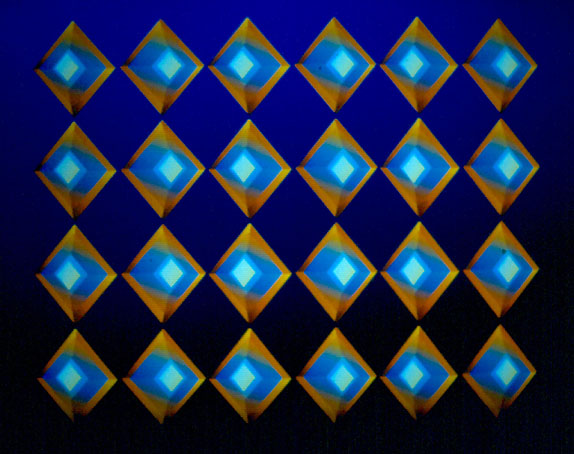
Pyramidal Force Field, 1988
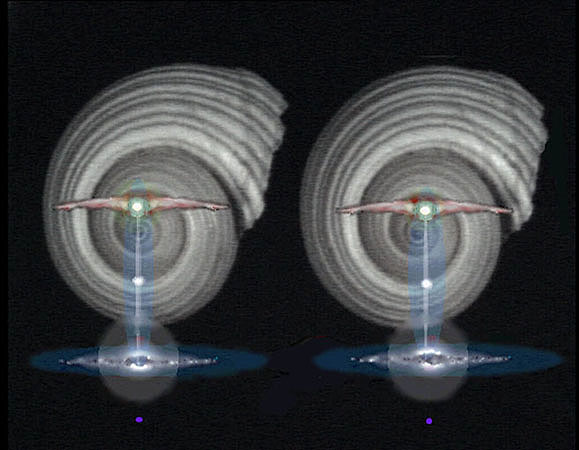
Coil of Life, 1989
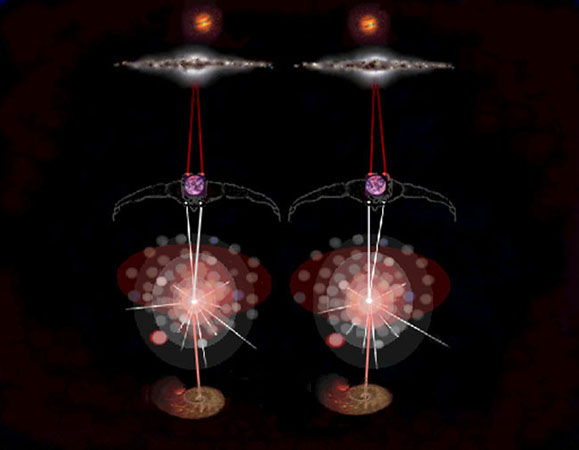
Cosmic Meditations, 1989
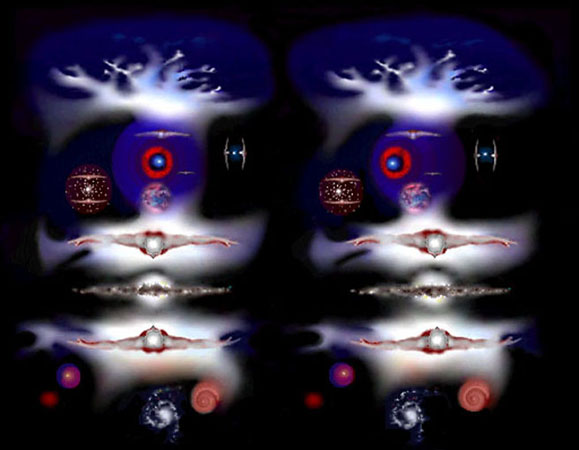
Nova Genesis, 1992
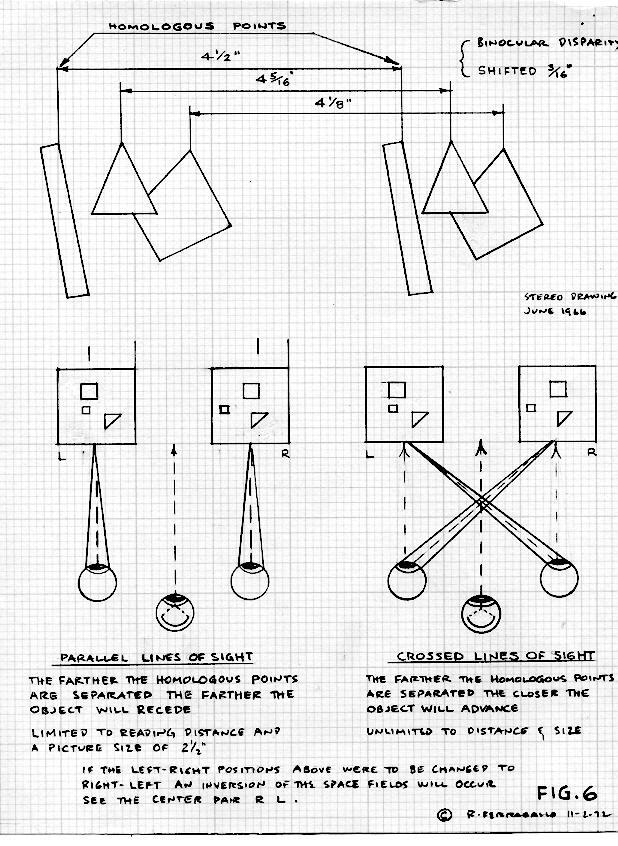
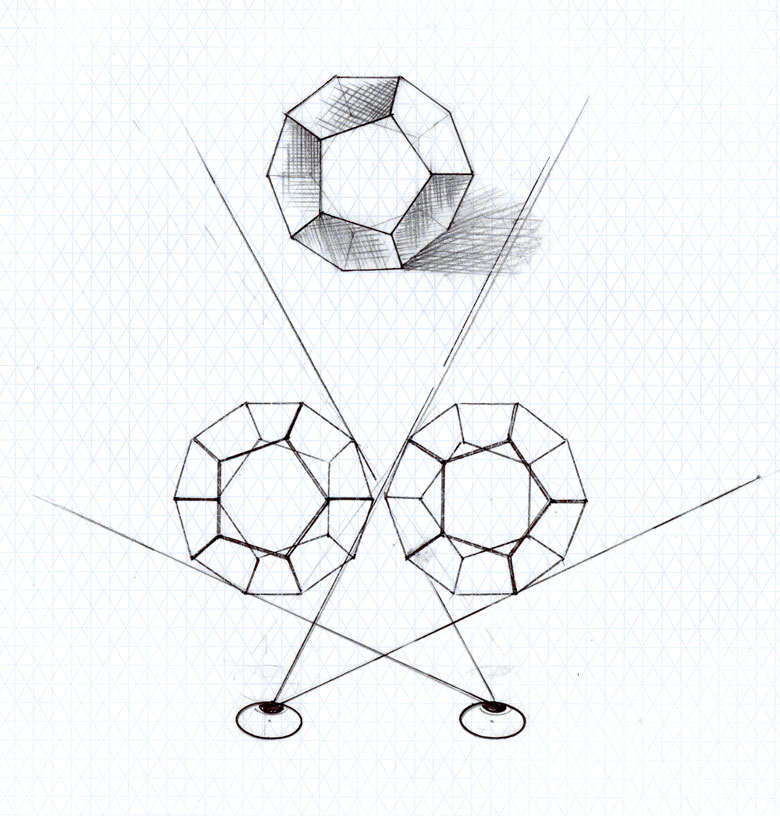
Two free-viewing methods: Straight-stare Parallel-vision and Cross-sight Free-vision
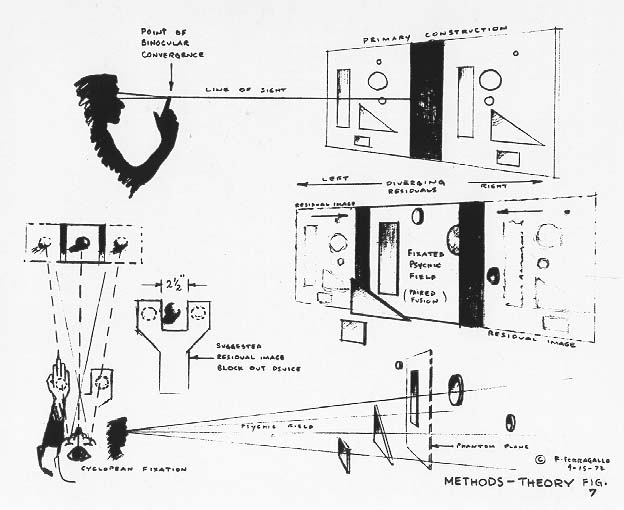
Each of the objects and painted forms are positioned to appear in stereoscopic 3D space by moving left-right eye-paired elements horizontally in relation to each other, illustrated in my graph paper sketches. To see the 3D effects in my stereo paintings, they must be viewed using the cross-sight free-vision technique rather than the straight-stare parallel-vision technique.
Thus the process of cross-sight free-vision with the new digital medium involved a real-time dynamic process that made it possible to paint with photonic light my sixty-plus cosmic works.
 cross-sight free-vision (unlimited scale of stereo pair artwork)
 straight-stare parallel-vision (paired objects cannot exceed the separation distance between human eyes)
In Japan, it is common for school children to be taught, at an early age, to view both parallel and cross-view stereo pairs. Parallel viewing, using the straight-stare parallel-vision technique, comes into play for small stereo artworks comprised of small repeated shapes. Because of the limits of the technique, the paired objects cannot exceed the separation distance between human eyes, or about 2 and 1⁄4 inches. Conversely, the cross-sight free-vision method has no dual eye separation limitation whatsoever. With the cross-sight technique, there is no limit to the size or scale of a work of art. That is why all of my stereo work, both small and large, exclusively utilizes the cross-sight viewing technique.
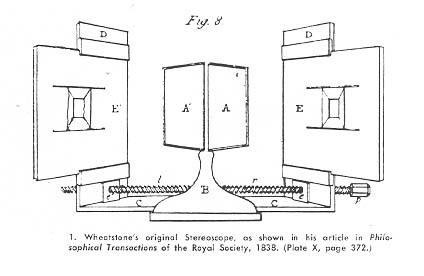
Normal stereovision automatically occurs in our brain when we focus on any object, near or far, in space with both of our eyes open. One can create objects on a sheet of paper that, in effect, make it possible to be viewed stereoscopically. The mind — the cyclopean eye — remarkably fuses two disparate left/right images to see them as one 3D reality. This great discovery was made by Charles Wheatstone in 1838. Wheatstone designed a device with two small frontal mirrors that reflect two hand drawn left and right disparate images that the brain fuses into one stereo reality.
Wheatstone Mirror System (1838)
Ferragallo Cross-viewing Method, 1972
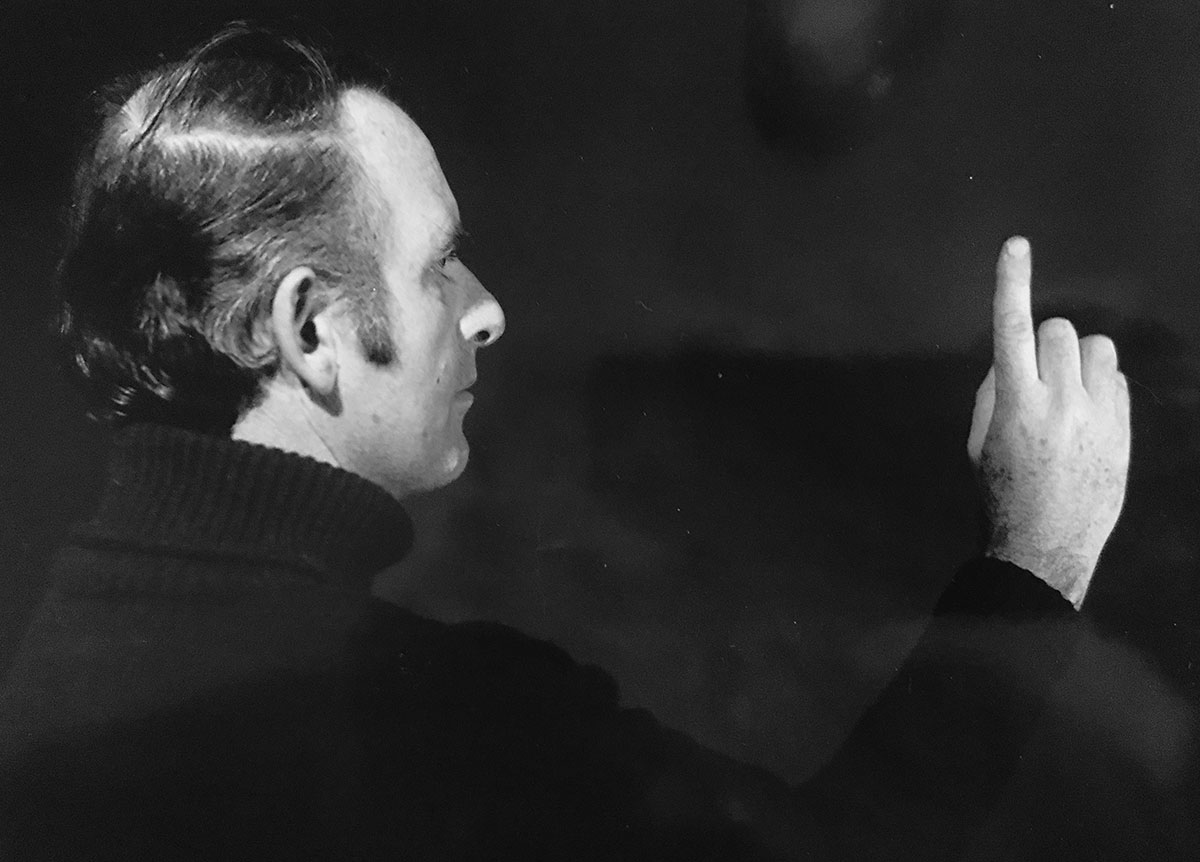
Roger Ferragallo Demonstrates the Cross-viewing Method
You stare—and willfully converge your eyes at your finger tip and at the same time observe the dual construction ahead as it divides into three images. It is at this instant that you stare at the third ‘central’ image—you gaze—concentrate—meditate fixedly upon the center image until it comes on you—and it will—with the clarity and power of sudden revelation. The painted forms will be seen to exist in real space, actually and concretely, as if in the nether world of dreams, you have just opened a cyclopean middle eye. Roger Ferragallo, “On Stereoscopic Painting,” Leonardo International Journal , Vol 7 No.2, Spring 1974.
Stereoscopic Architectural Surfaces, 1995
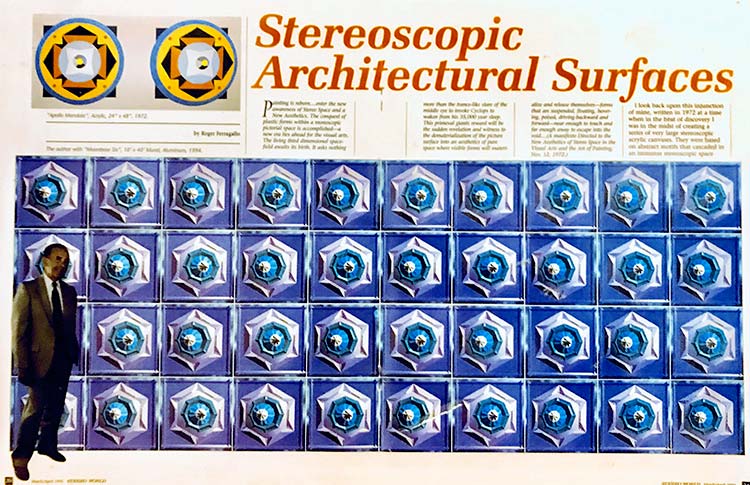
StereoWorld, March 1995, depicting Moonbase 6, 10′ × 40′ Mural, Aluminum, 1994
Painting is reborn….Enter the new awareness of Stereo Space and a New Aesthetics. The conquest of plastic forms within a monoscopic pictorial space is accomplished—a new era lies ahead for the visual arts. The living third dimensional space-field awaits its birth. It asks nothing more than the trance-like stare of the middle eye to invoke the Cyclops to waken from his 35,000 year sleep. This primeval giant’s reward will be the sudden revelation and witness to the dematerialization of the picture surface into an aesthetics of pure space where visible forms will materialize and release themselves—forms that are suspended, floating, hovering, poised, driving backward and forward—near enough to touch and far enough away to escape into the void… Roger Ferragallo, A Manifesto Directed to the New Aesthetics of Stereo Space, Visual Arts and the Art of Painting, Nov. 12, 1972.
I look back upon this injunction of mine, written in 1972 at a time, when in the heat of discovery, I was in the midst of creating a series of very large stereoscopic acrylic canvases. They were based on motifs that cascaded in an immense stereoscopic space.
The Decade of the 1990s Seven Large Cosmic Paintings
With the sixty stereoscopic cosmic paintings largely completed, I began musing about what should follow these lovely spatial geometries. The late 1980s brought on new science, images, articles, and books that came as a flood with cosmic themes that excited me. Wonderful paint software also began to appear in the marketplace in 1990 along with digital print shops that could produce museum quality prints—Giclee and Iris—on large canvas and paper substrates. These had exceptional resolution and luminal color fidelity. The prospect of creating bigger works allowed me to embrace comprehensive themes with a more painterly visual language. It was a breakaway moment that caused me to produce a series of large paintings.
Seven paintings, created between 1992 to 1997, opened the path to deeper complexities of bio-cosmic expression utilizing ‘illusion of depth’ modeling and painting with three dimensional perspective.
[Links lead to other pages on this website.]
-
Anthropogenesis 1992
-
Nova Genesis 1993–94
-
I Am What I See 1994
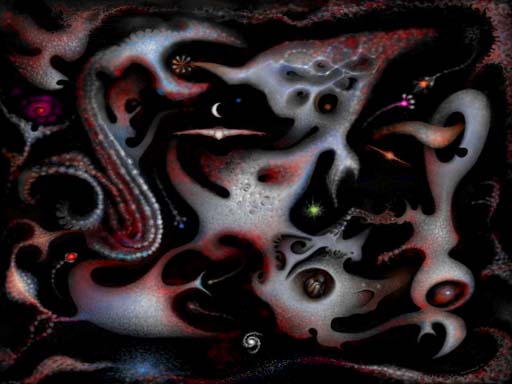
Anthropogenesis, 1992
I proceeded with the first of seven new cosmic paintings, titling it Anthropogenesis, and had this to say about it in 1992:
The digital process of freely panning and zooming into micro-macro deep scalar space is liberating and aesthetically satisfying. I view my monitor canvas as a night black atmosphere that anticipates emerging light, setting before me a sense of creation and mystery. My approach is painterly in that I utilize my digital paint software as I would oil pigment that can be molded fluidly and variously with the use of a pressure sensitive pen stylus. I begin by illumining amorphous forms and symbols. I try not to lose contact with my inner world in the sense that I keep unconscious and conscious mind engaged, opening myself to motifs that draw inspiration from my interest in human nature, evolution, physics, and the sciences with a particular attraction to astronomy and cosmology. Additionally, this blending of form and idea motifs echoes my absorption with human scale, cosmic connectedness, and meaning. My work is generally driven by a bio-cosmic universe appearing incredibly patterned, alive, complicated, utterly mysterious, and hauntingly beautiful—as well as unsettling and disturbing. I attempt in my work to evoke a cosmic reality that is fundamentally poetic, symbolic, interdependent, and touching all of us. Roger Ferragallo, 1992
Approaching the completion of Anthropogenesis—brushes laden with colored light within the confines of a small cathode monitor—was a most exhilarating experience. Depicting bio-cosmic themes with dynamic zoom within the reaches of deep space rendered an inimitable air of immediacy and excitement that marshaled a living scalar space plumbing my deepest feelings of numinous cosmic connection.
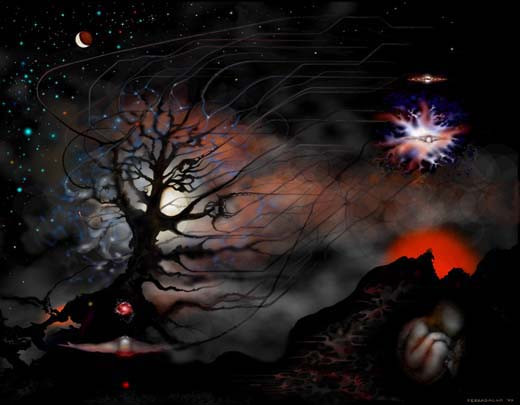
Nova Genesis, 1993–94
I single out the painting Nova Genesis because it personifies all seven works at a time I could, at last, paint cosmic works in flowing photonic color and light. I would go on to widely exhibit this series locally and around the country, printing them to canvas cloth or archival museum paper. I also committed several paintings to large Fujichrome transparencies, illuminated from the rear by enclosure within large metal light boxes.
Nova Genesis, thematically, had its anthropic origin in explosive supernovae that make possible the wonder and emergence of life as we know it. Supernovae, particularly, when they cataclysmically implode and explode, make possible the metallicity of planets and, in our instance, biogenetic evolution. When a Type II supernova star core collapses—it must have more than eight times the mass of our Sun—it reaches a criticality that no force in the universe can stop. An iron red core catastrophically implodes and instantaneously explodes to disperse molecular clouds of dust, cosmic rays, and complex organic elements into the depths of interstellar space. In a sense, it showers its fertile elemental contents to plow the circumstellar vastness of the galactic medium. They are the elements that make up stars, planets, and all life. Stars and supernovae underlie all the elements in the Periodic Table, without which DNA, nor life as we know it, would exist in our Milky Way. Within a galaxy, supernovae are few and far between.
A recent supernova found in a satellite galaxy to our Milky Way, the Large Magellanic Cloud, happened on February 23, 1987 (left), while the last to explode inside our Milky Way was witnessed by Johannes Kepler in 1604. Its remnants can still be seen today (right).
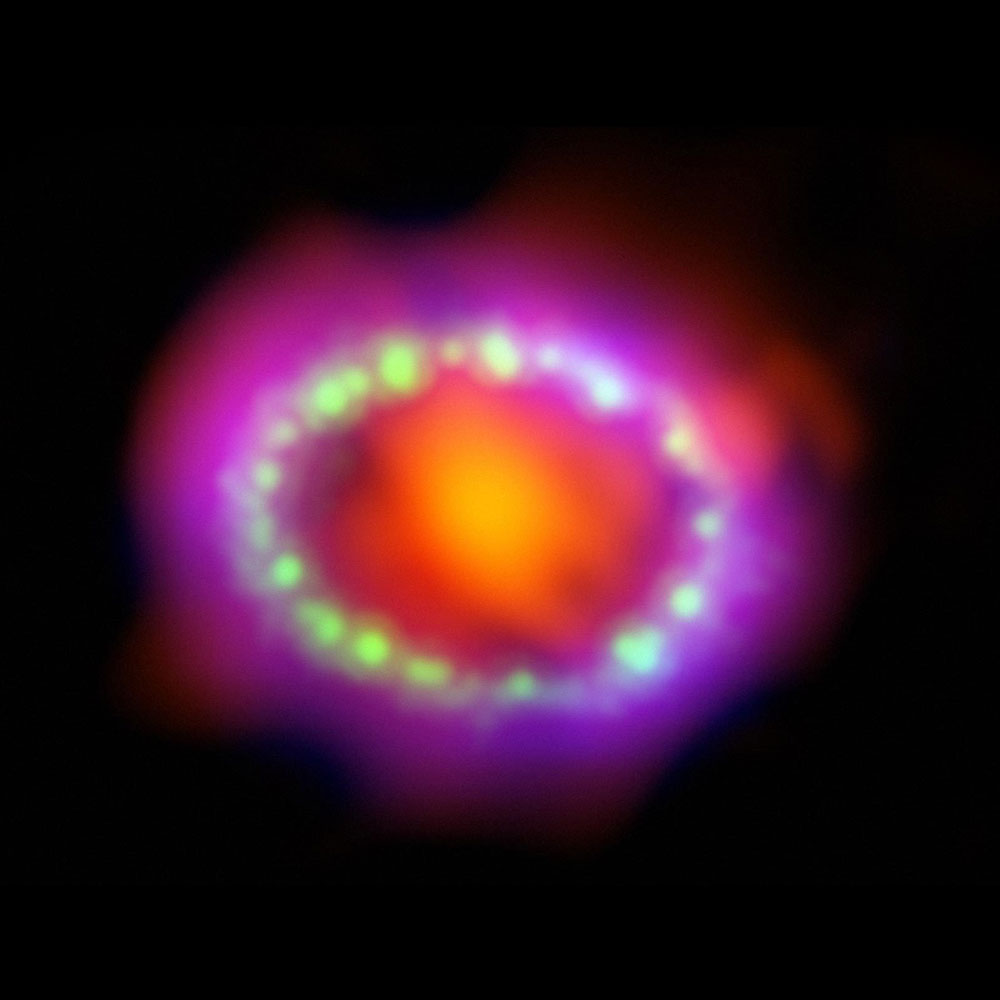
1987A Supernova, Large Magellanic Cloud, 1987
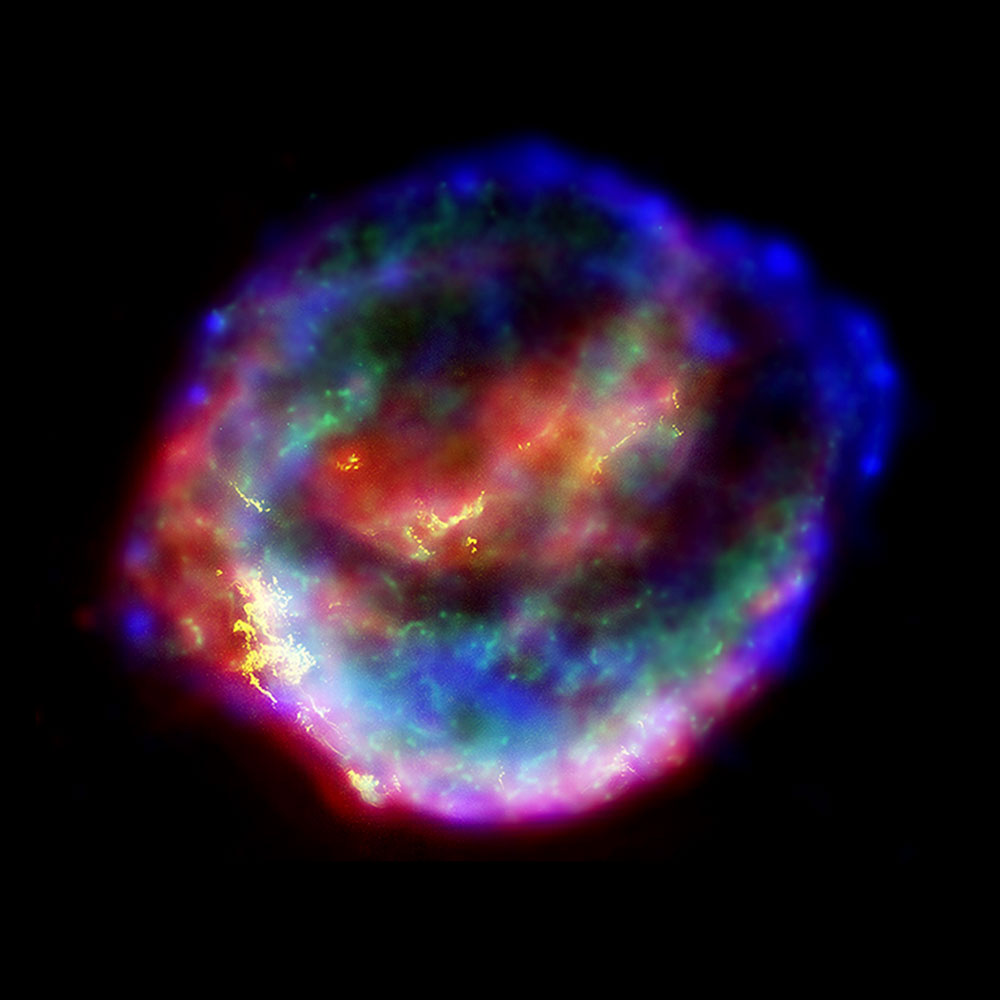
Kepler Supernova, Milky Way, 1604
As the millennium approached, each of the seven paintings brought me ever closer to viewing my 17″ cathode screen as more than a small light generator. It was the entrée to solar planetary life and the vast mysterious universe that abounds in organic elements and molecular clouds throughout the interstellar beyond. As the decade came to a close, I sensed the need to break away from my individuated thematic works to favor a more wide-ranging cosmic work commensurate with the greater cosmos with all its diverse mysterious patterns and aesthetic beauty.
The Universe Knew We Were Coming Approaching the Millennium, 1998–2001
The seven larger scale paintings had served me well and were, by 1998–99, but cosmic threads in search of a broader thematic holism. It was an insightful moment—the cosmic subject too compelling and huge to contain the busy voices crowding my mind. The millennium air materialized into a photonic vision of a more wide-ranging visual vocabulary that would celebrate the vastness and complexity of the universe we observe! As a result, I chose my next painting to embrace a larger canvas ‘stage’ and to explore a more far-reaching comprehensive vision.
I proceeded with The Universe Knew We Were Coming.
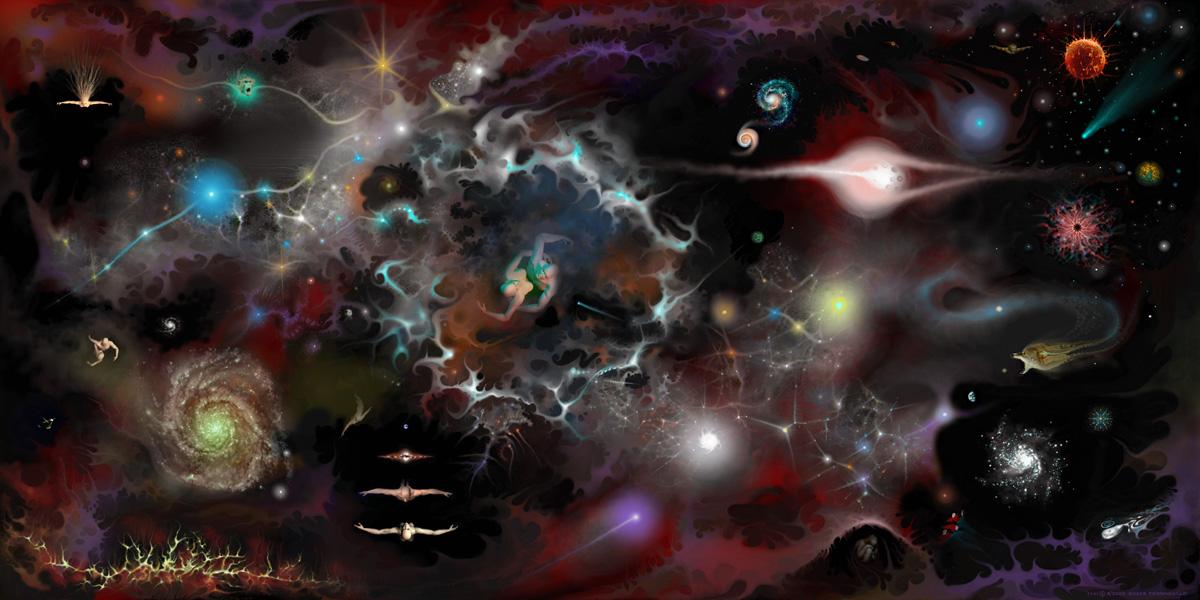
The Universe Knew We Were Coming, 24″ × 48″, Printed to Canvas, 1998–2001
The Universe Knew We Were Coming painting was conceived as a holistic bio-friendly cosmology to inspire a new artistic genre towards an art-science that could best be expressed through the all embracing luminal digital language. I could now proceed with a plethora of cosmic themes on a larger digital stage to paint with photonic light elements that speak to life, evolution, world, and universe. Indeed, our evolution gives us license to affirm the “universe knew we were coming” (Dyson) because “we are here as ‘conscious’ anthropic witnesses,” given the universal agency of cosmic fine-tuned physical constants and the realities of galaxies and supernovae. Accordingly, I began with a larger, more inclusive, 108 megapixel, 48″ × 24″ cosmic landscape, that arose from the unconscious to explore the mystery of conscious existence.
It was a humbling moment to gaze into the mysterious frigid darkness and heat from the colossus of galactic interstellar space to awaken the cathode of electronic light, universe, and mind. The photonic medium made it possible to magically circum-zoom the depths of interstellar space on my now 21″ cathode monitor with luminal imagery at all spatial micro-macro scales. I began The Universe Knew We Were Coming in November 1988. The following images are close-ups from the painting.
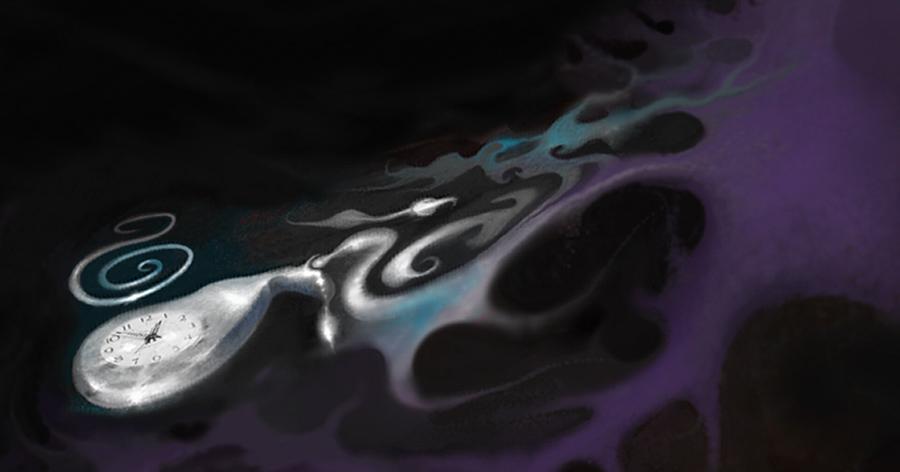
River of Entangled Time
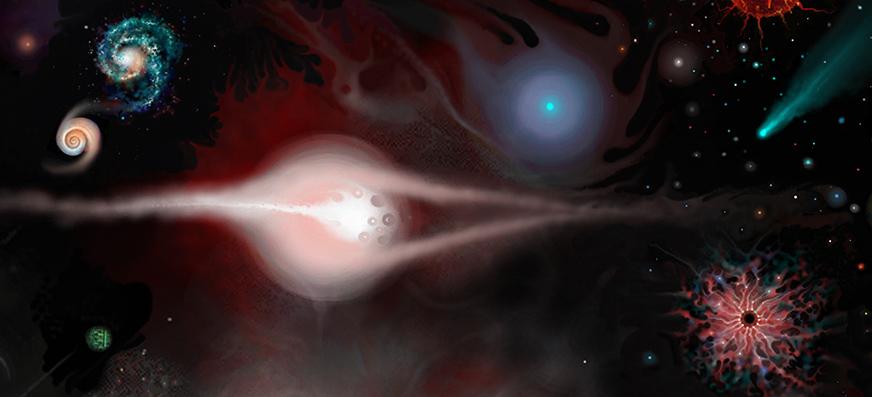
Cosmic Ghost: The Comber of Star Dust
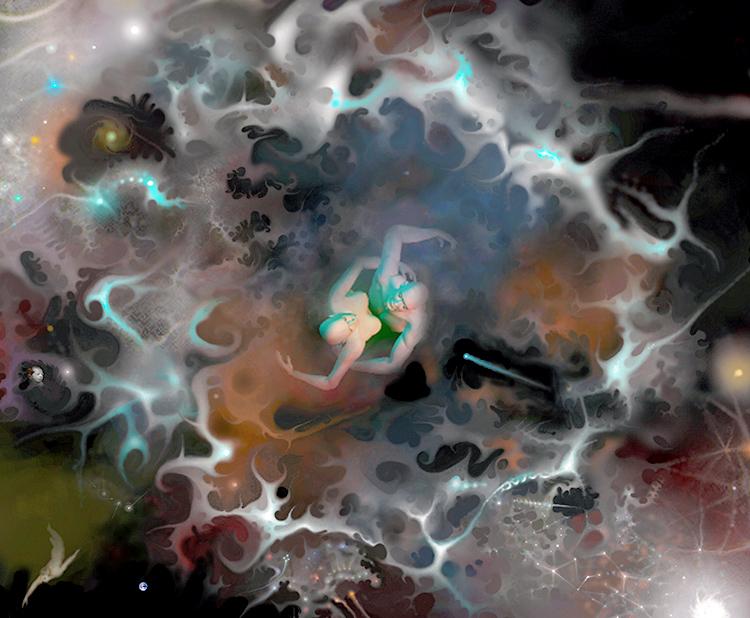
Galactic Encirclement as Reverie
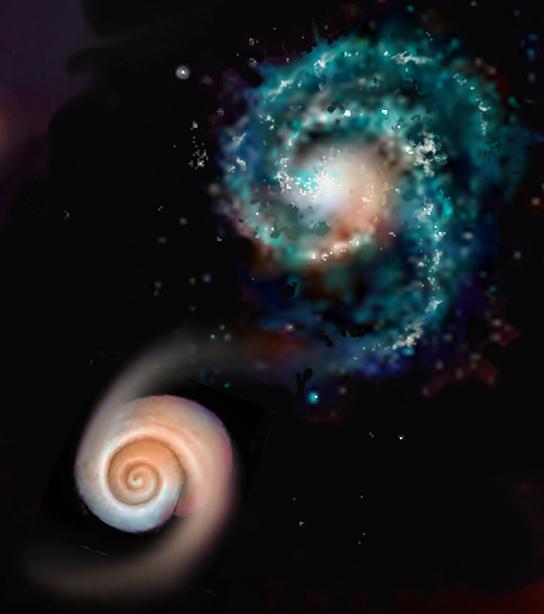
Coil of Life
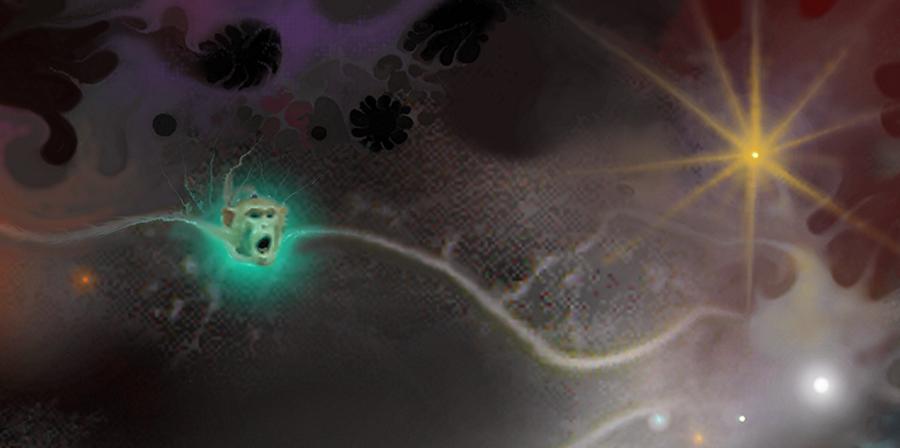
Howling Terror in the Quantum Cosmos
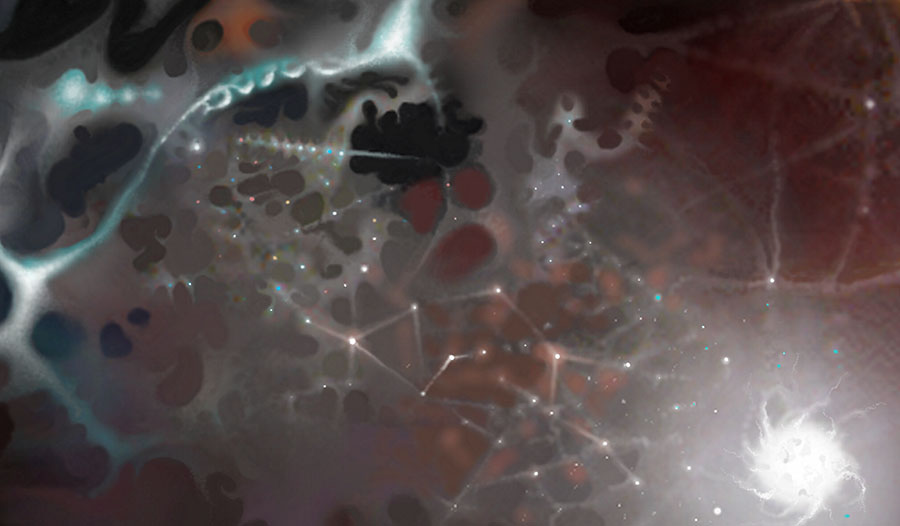
Galactic Link
I engaged themes that ran from harmonious to wild, questioning an aegis spectrum that sought a participatory anthropic universe suited to the emergence of life and cosmos. My image themes appear as mystical cosmic forms, appearances, and metaphor to address our evolution and the phenomenal reality of our galactic home. The infinite beyond of trillions of galaxies weighed heavily as I pondered the incredulous vantage point of our sapient evolution on this infinitesimal ‘pale blue dot’ traveling the measureless immensity of space. I sought the interstellar deep with imagination ablaze. Causal life within us must have its strange moment of space-time evolution and dominion within the open arms of cosmic conscious life and solar warmth.
- Roger Ferragallo
- Dr. Hal Layer, San Francisco State College
- January 11, 2000
-
Dear Hal,
What is even stranger than mere “sadness” is that your reference to our inability to follow our own plans has everything to do with the awesome power that has been seeded here by others or driven through billions of years of evolution to create a being with enough DNA, if unfolded and lined up end to end, to stretch beyond the earth to the moon and back—not once but over a million times! (Lynn Margulis).
We now stand at the start of a new millennium—thanks to our evolution or some seed born from a comets tail as a species able to create a Blue Gene and beyond as though we are gods! Are we? I suggest this is an open question! Look back to the oxygen crisis that befell prokaryotic cell life 2.2 billion years ago, initiating evolution to respond in the form of oxygen processing mitochondria that inhabit all eukaryotic cell life! Perhaps we may one day find ourselves serving the body of some new bio-digital life form.
When Blue Gene or its descendent has it figured out, the few of us simians left, like our dependable friend the mitochondria, may well find us fellow travelers to live on for the greater cosmic imperative. It’s an interesting footnote how inextricably tied we are to sentient intelligence to know that a precise 21% oxygen level absolutely must be maintained (as it has for billions of years) to sustain life as we know it!
Life is a force with so stubborn a foothold on Earth that it may well subsume a novel form of conscious presence to advance our cosmic evolution!
Roger
“The Universe Knew…” at Midpoint, 2000–01
With the millennium’s wild wind at my back, my “The Universe Knew…” cosmo-lightscape underwent content and high resolution changes due to constant in and out circum-zooming of image and form in my search for meaning. As I neared the completion of this work, painting with light, there were moments that the unremitting electronic hum and din of my light generator machine breached ear and eye, tuning within me awe and wonder as I painted through many nights of reverie. The painting had grown evermore a cosmic phantasm, peopled with all manner of life and mystery.
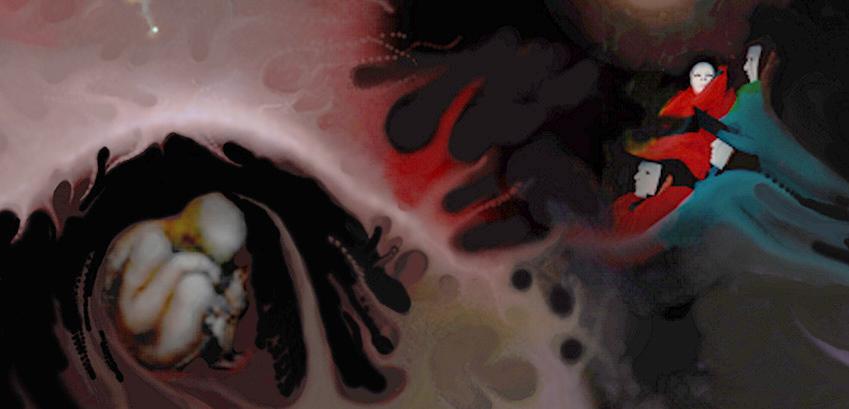
Guardians of the Cosmic Cove, Detail from “The Universe Knew…”
New science and philosophical ideas a constant driving force, I pondered the expressive possibilities that rest within the revolution of computers and their radiant screens along with the appearance of larger quality screens seen at various computer expositions. In 1999, liquid crystal displays and brilliant plasma screens emerged approaching 40″ to 50″, giving heart to all the resolution that I was pouring into my work. I found improved digital tools with a variety hand stylus brushes and luminal color palettes with ever increasing color depth that dazzled me.
With “The Universe Knew…” painting completed in 2001, I looked to print this work to stretched canvas since I located, on line, a company specializing in a process called Digitograph that offered printing using oil base dyes, electrically fixed to Mylar, sealed on a stretched canvas. My email to the Digitograph Studio follows:
- Roger Ferragallo
- Tim Siahatgar, CRA/Digitograph Studio
- August 05, 2001
-
I am enclosing a new version of “The Universe Knew We Were Coming” on a Jaz Drive as you suggested. While I was at it, I worked an additional 60 hours on the piece both to correct some artifacts and to further enhance the original. In regards to my recent e-mail concerning enlarging the piece to possibly 40″ or 50″ I will leave to you. I chose to go with 216 megs and a size of 48″ × 24″ which might be the limit of fine resolution of the human figures critical to the work. Phone me if you see a problem.
The Digitograph process surprisingly allowed me to the utilize actual oil pigment which blended well with the digitally printed canvas. I would later seek out the reality of light itself to exhibit the work. I chose to have “The Universe Knew…” painting digitally reproduced as a large Fujichrome film transparency, enclosing it inside a large 50″ width metal light box to backlight the work to great effect at a gallery and other exhibition venues.
Advent of the Ferragallo.com Website Artist, Webmaster: Niffer Desmond, 1998–2002
As the millennium approached, I had the pleasure of meeting the talented artist, designer, and webmaster, Niffer Desmond. She was introduced to me in the late 1990s by my artist-technologist niece, Caitlyn Meeks Ferragallo. Niffer Desmond went on to establish and design the new comprehensive ferragallo.com website in 2001–02 that autobiographically covered my entire complex career, summarizing my experience as a filmmaker, industrial and graphics designer, and set designer for theater and modern dance. Niffer continues to update the website. This opened the dike to a worldwide presence that brought me a global avalanche of attention and opportunity.
Germany Calls Rolf Henkel, 2001
My global web presence played its part during this period at the millennium. I was surprised and delighted to receive an email from Dr. Rolf Henkel of the Institute for Theoretical Neurophysics, at the University of Bremen, Germany.
- Dr. Rolf Henkel
- Roger Ferragallo
- April 07, 2001 5:36:19 AM PDT
-
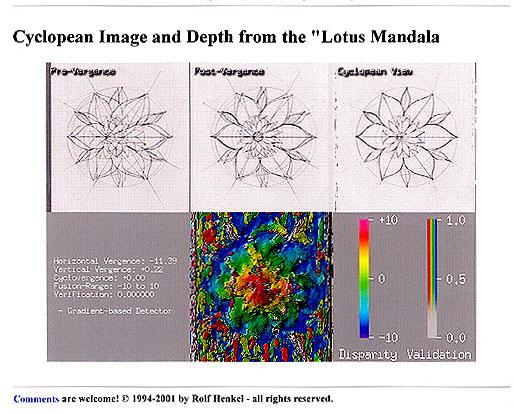
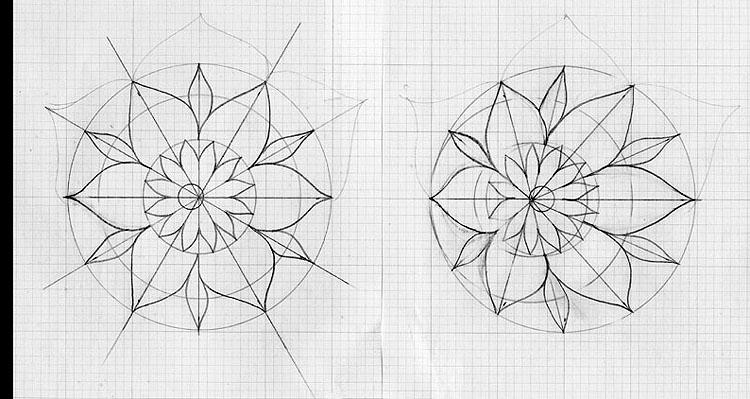
By chance, I came across your website displaying stereoscopic paintings of Roger Ferragallo. I am doing research in stereovision, and run an online image processing facility where you can calculate depths out of stereo images (check the link below). Of course, I could not resist trying my algorithm on one of the displayed paintings (the “lotus mandala”)
Thought you might be interested in what came out of this, so I have attached the result to this email. The recovered depth is color-coded, and it turned out to look quite nice.
Regards,
Rolf Henkel
Henkel sent me a stereo disparity study of my drawing, based on the unique algorithm he created (below).
Lotus Mandala Study, Rolf Henkel, 2001
Lotus Mandala Stereo Drawing, Roger Ferragallo, 1972
Rolf was also attracted to the new work, The Universe Knew We Were Coming and its underlying anthropic concept. In the midst of our theoretical discussions, he created a series of four algorithmic high resolution versions of “The Universe Knew…” painting that imparted a welcome ghostly mystique. We shared theoretical, technological, and philosophical interests over many years. Rolf contributed mightily to my ongoing work on a collegial and personal level that continues to this day.
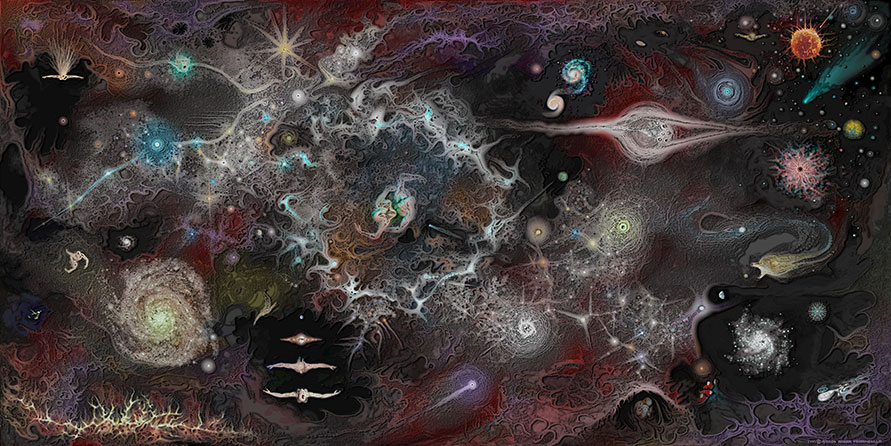
The Universe Knew We Were Coming, Algorithm 1 of 4 by Rolf Henkel, 2001
Crossing the Millennium Ferment and Change, 2001–02
When I completed “The Universe Knew…” painting in 2001, I questioned what my next painting would embrace to build upon the Anthropic Principle. Philosophical uncertainty lingered regarding the depth and breadth of quantum and cosmological theoretical articles, papers, and books that consumed my studies. I sought clarity and inspiration and found myself philosophically ill at ease as I planned my next painting. Emails to friends, Caitlyn, Hal Layer, and Niffer Desmond mark the unrest and anxiety I felt about new subsequent work.
- Roger Ferragallo
- Dr. Hal Layer, San Francisco State College
- November 11, 2002
-
Dear Hal,
Tom Bell did finally prove Einstein wrong and Heisenberg right because God does indeed appear to absolutely play dice because we now know, at the quantum level probability, indeterminism and chance rules!
As a result of this, I’ve come to a crisis point with my cosmic painting, unable to move my digital wand since I’m at an impasse to make sense of quantum concepts like tunneling, teleportation, entanglement, and “many world” cosmologies as relates to the Anthropic Principle. So, for months, I’ve been living at my local Barnes & Noble reading book after book, trying to come to grips with the philosophical crisis I am feeling. After painting “The Universe Knew We Were Coming,” I am at a loss until I can break through this bottleneck. My main thrust as an artist explorer is to paint the messages of my soul within the natural medium of cosmic imagery. Perhaps, I’ve reached the plateau that Marcel Duchamp suffered when he gave up painting and took up chess! But I am in too much aesthetic discomfort to let “it” go! Or should I say there is fire in my belly that leads me either to my next painting or to joining Duchamp!
Roger
- Roger Ferragallo
- Niffer Desmond, Webmaster
- November 14, 2002
-
Dear Niffer:
My study of Cosmology only lately brought Quantum Mechanics to the forefront and it is too compelling to ignore. I feel an urgency to understand QM and its consequences to the spirit that drives me to create. I suspect the inner crisis I feel has been building for some time now. “The Universe Knew We Were Coming” was joyfully produced and was the last of works primarily based on anthropic ideas that felt natural to me. Life and universe, as we know it, came into existence as the result of fine tuned fundamental constants that to move any one constant by fractions of a decimal point would have rendered human life and consciousness impossible.
I wasn’t prepared for QM! And not prepared, certainly, for Jeffrey Satinover’s “The Quantum Brain” that I just finished reading. I was led to this book by several others: “The Universe Next Door”, Marcus Chown; “Nature Loves To Hide”, Shimon Malin; “The Undivided Universe” Bohm; “The Ghost In The Atom”, Davies; “Beyond Einstein” Michio Kaku; “A Hole In The Universe”, KC Cole; “The Book Of Nothing”, John Barrow.....and on and on....to name but a few!
At another time, I’ll attempt to explain in more detail why I feel in such a state of ferment. I cannot paint without feeling the passion that has always driven me to create. I’m stunned by the absurd consequences of QM. I am also enthralled by a possible vision of beauty that lies just ‘beyond the touch of mind’ in concert with others.
Roger
“Beyond the Touch of Mind”
The multi-year process of creating The Universe Knew We Were Coming caused me to recognize the digital constant circum-zoom process contained the seeds of a breakthrough methodology. The digital process I employed from the early 1990s led me to fluidly work with tablet wand in hand through years of relentless panning and deep zooming luminal forms across many micro-macro scales of magnitude. Thus I became acutely aware of the dynamic nature of painting with light, given the digital medium with its instant immediacy to modify color, form, imagery, and meaning within the zoom depths of macro-micro space. My electronic screen triggered me to view space differently—as if I were sky diving—breaking the picture frame inward and outward bound into self similar fractal image spatial domains of cosmic discovery to explore a broader visual language capable of expressing extraordinary new science and philosophical ideas to breach size, scale, aesthetic distance, and time. In a flash of insight, I grasped the broader aesthetic of a new cosmic work!
It was a startling awakening that shed an avalanche of initiatives: I came face to face with the picture of a digital medium that would make possible interaction and involvement of both viewer and artist. I sensed a participatory concept at hand that could breach the holy grail of closing the aesthetic distance between the observer and painted object. Here was an aesthetic born from a light medium I felt must be viewed in the same emissive photonic light from which it was painted! Furthermore, the digital process of years of constant circum-zoom-panning would have causal expressive effect. I envisioned audiences who would actively participate and circum-zoom this new work on large plasma screens with hand control devices that began appearing in the marketplace at computer expositions.
Today, the touch of two fingers on mobile phone screens reaches the planet through a cloud of algorithms.
Cosmic Origins and Influences
Thus I proceeded with the painting as a comprehensive high resolution work of cosmic exploration and discovery within the practice of imagery and metaphor as an artist. Art and Science consciously partner to explore the enigmatic universe. Why do we stardust beings, at the fulcrum of billions of years of unique evolution, stand on this infinitesimal mote of rock, water, and soil with the power of mind in the twenty-first century driven to investigate the vast universe we consciously create? To what end, we ask? The gift of life appears poised as cosmic imperative to galactic flight into the solar system and beyond interstellar space. What is to be rendered with image and metaphor to subsume the Anthropic Principle, fundamental parameters, constants, and laws? These have brought us to the brink of searching entanglement physics and the quandary of quantum mechanics relating to the mystery of consciousness, evolution, science, and cosmology. My background in art history gave inspiration and voice to historic master painters who influenced me as I began to develop and paint The Cosmic Tree of Life.
Hieronymus Bosch, the Dutch Province master, with his triptych, The Garden of Earthly Delights, held a powerful attraction that inevitably resonated with the Tree of Life, having seen the huge original in Spain in 1971. Bosch lived in an era of unremitting religiosity as expressed in his work. Today, we harbor modern science and survey the vast galactic universe that we, stardust beings, take the measure of with awe and astonishment.
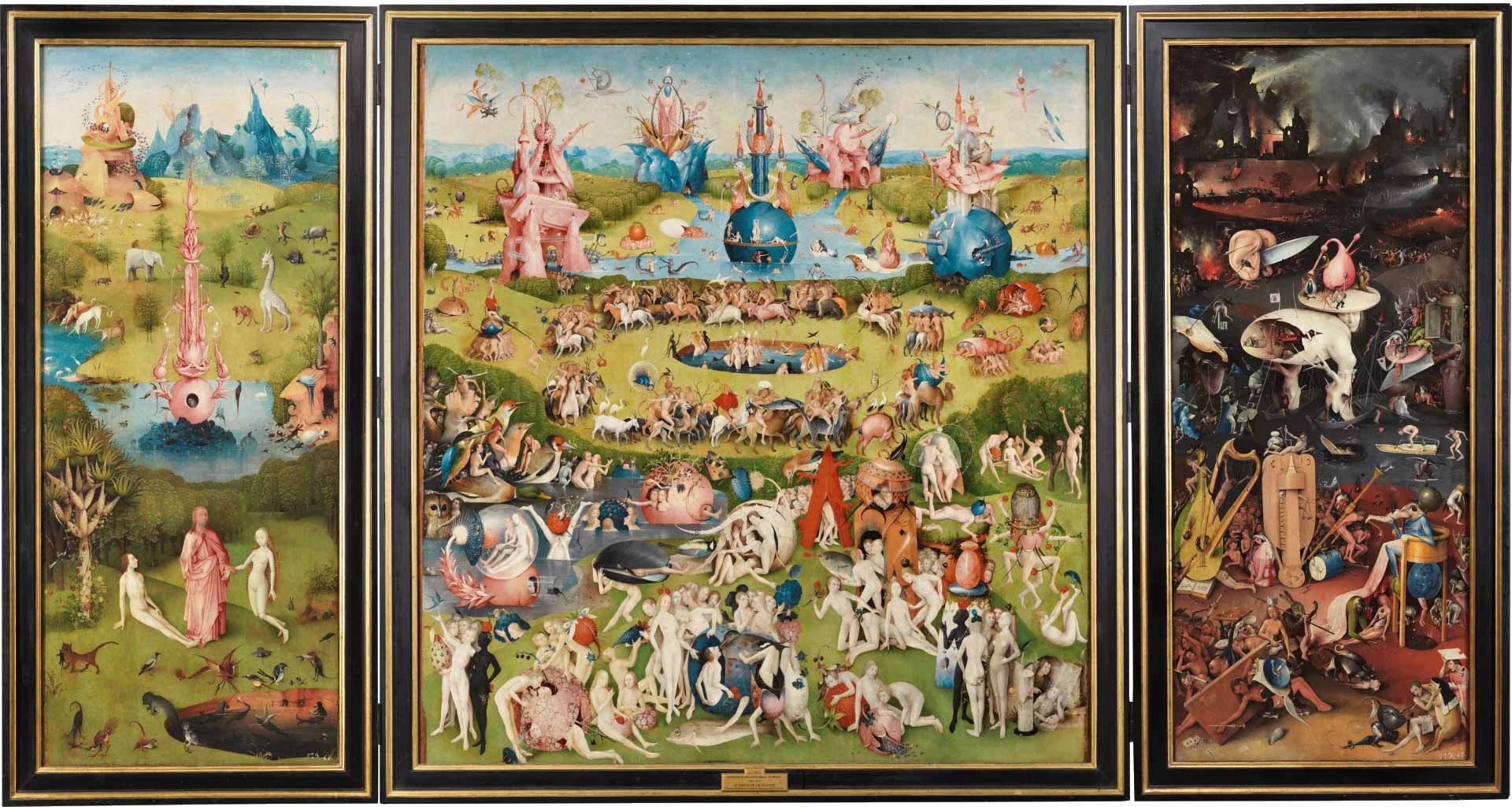
The Garden of Earthly Delights, Hieronymus Bosch, 153″ × 87″, 1492–1505
William Blake, English poet, artist, and printmaker, was unrecognized during his lifetime and is my most favored poet-artist in word and cosmic imagery. He cast a strong poetic and spiritual influence on me.
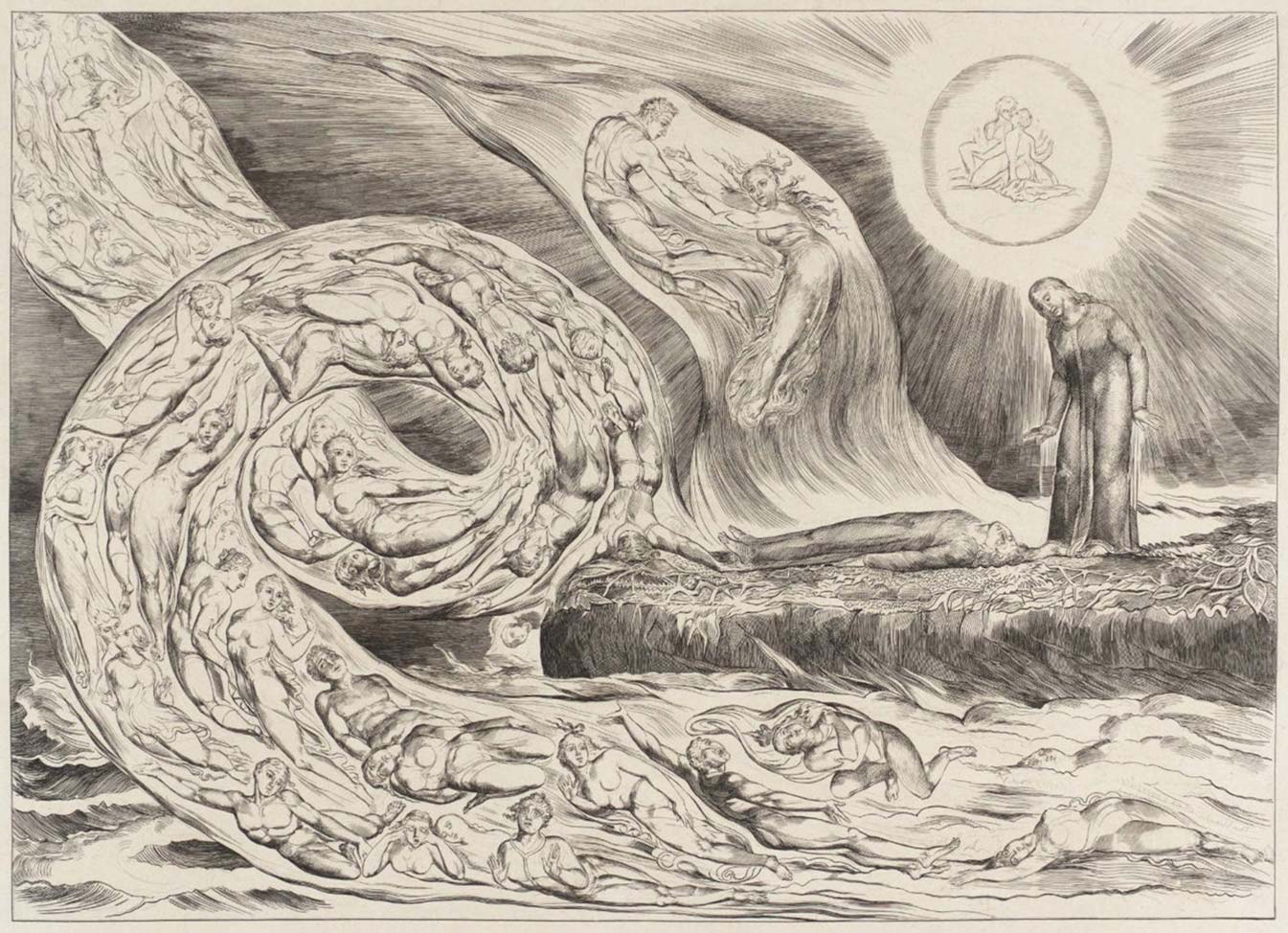
Whirlwind of Lovers, William Blake, 1824
My sabbatical time in Italy in 1971 did not fail to fill me with wonder and awe at the great ceiling frescos by Michelangelo and Andrea Pozzo.
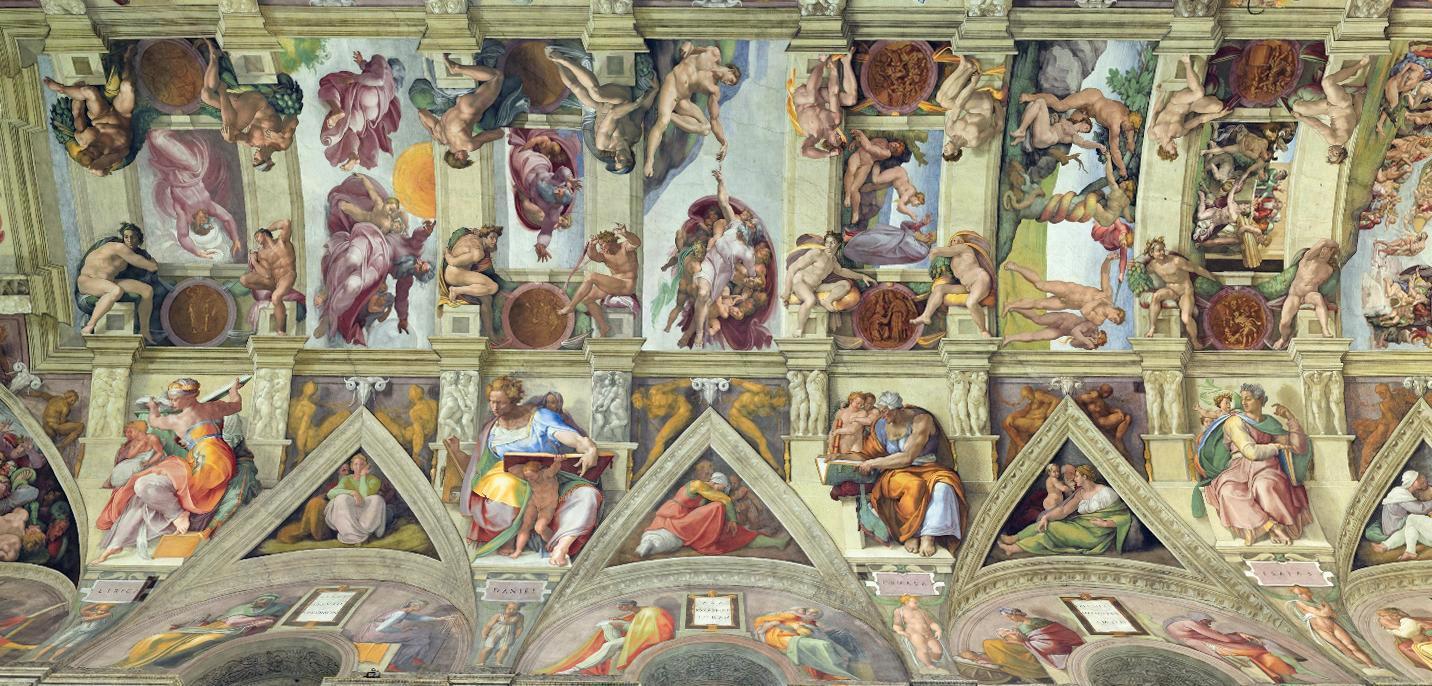
The Sistine Chapel Ceiling, Michelangelo, 1508–12.
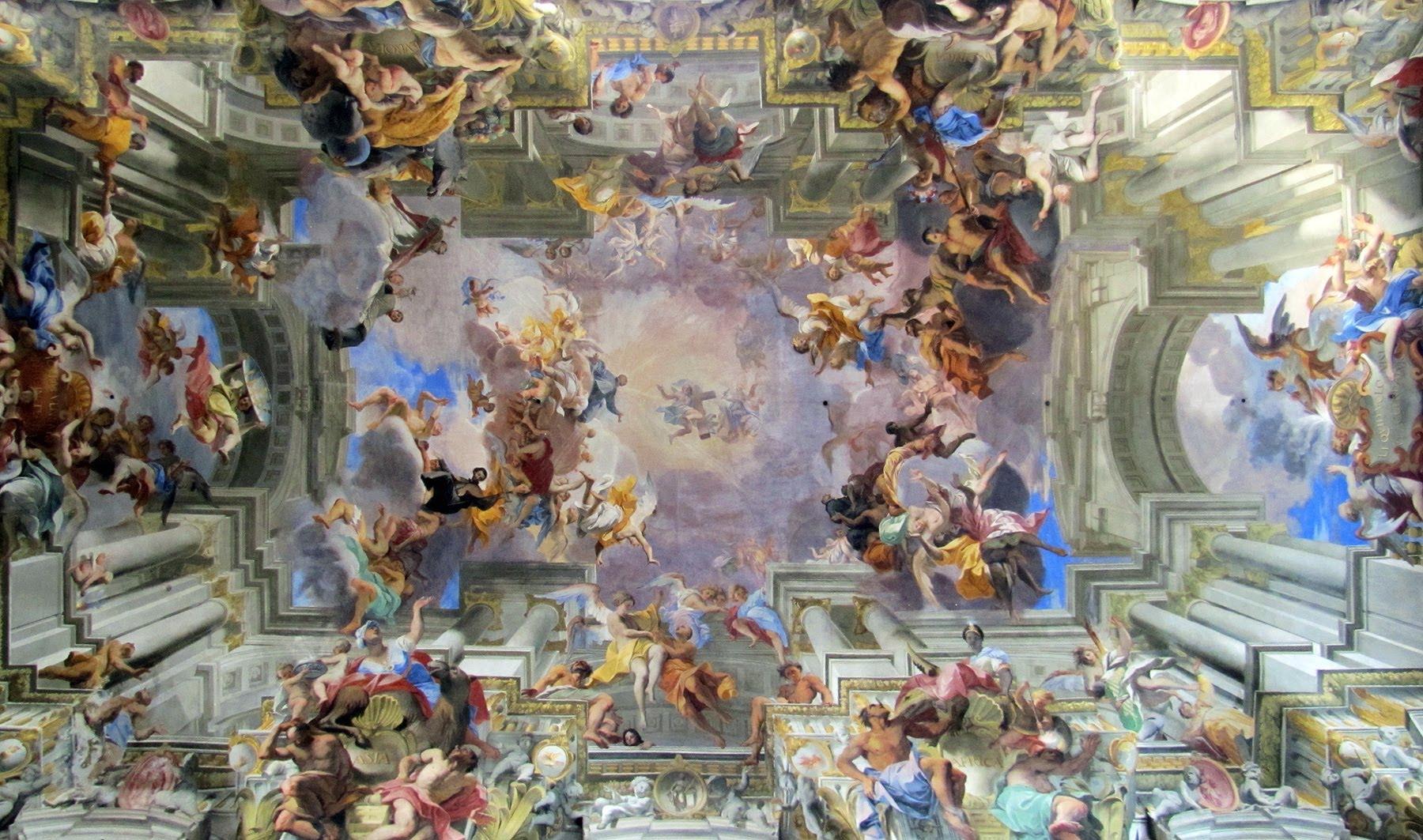
Apotheosis of Saint Ignatius, Andrea Pozzo, 1688–94.
I was deeply influenced by the modern Russian master, Pavel Tchelitchew’s Hide and Seek. I saw the impressive original at the Museum of Modern Art in New York and it directly influenced my cosmic work, Synaptic Fire in the Tree of Life, painted in 1994.
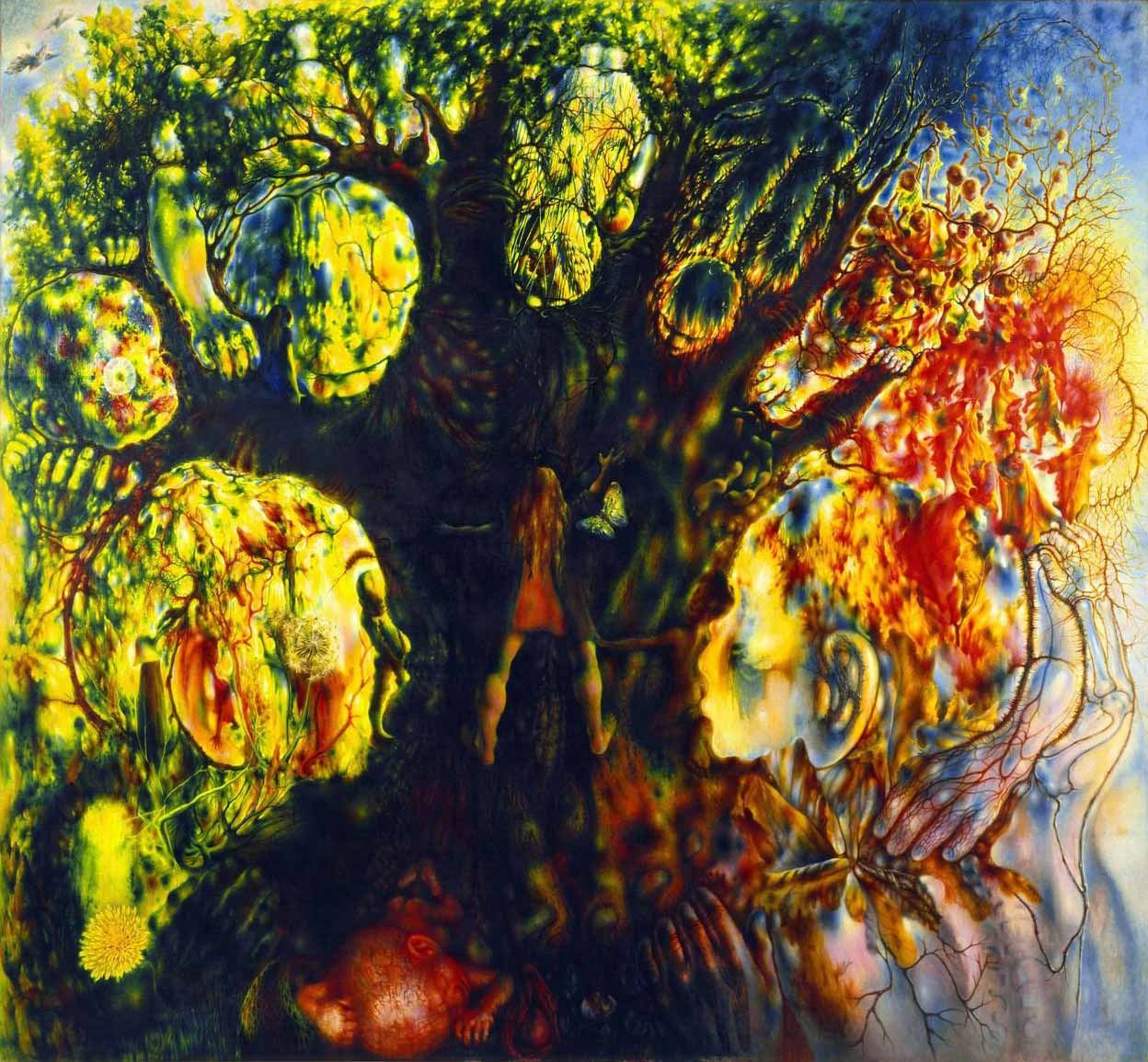
Hide and Seek, Pavel Tchelitchew, 78″ × 84″, 1942.
The “Tree of Life” Painting is Born, 2002–04
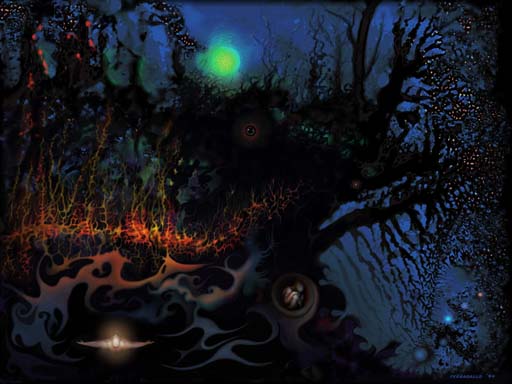
Synaptic Fire in the Tree of Life, Roger Ferragallo, 1994.
The foundation model I chose to kick-start the new painting was my earlier cosmic painting created in 1994 that resonated with me, titled Synaptic Fire in the Tree of Life (1994). The painting had a certain cosmic gravitas that set the tenor for The Cosmic Tree of Life.
Model 1: The Cosmic Tree of Life (CTOL)
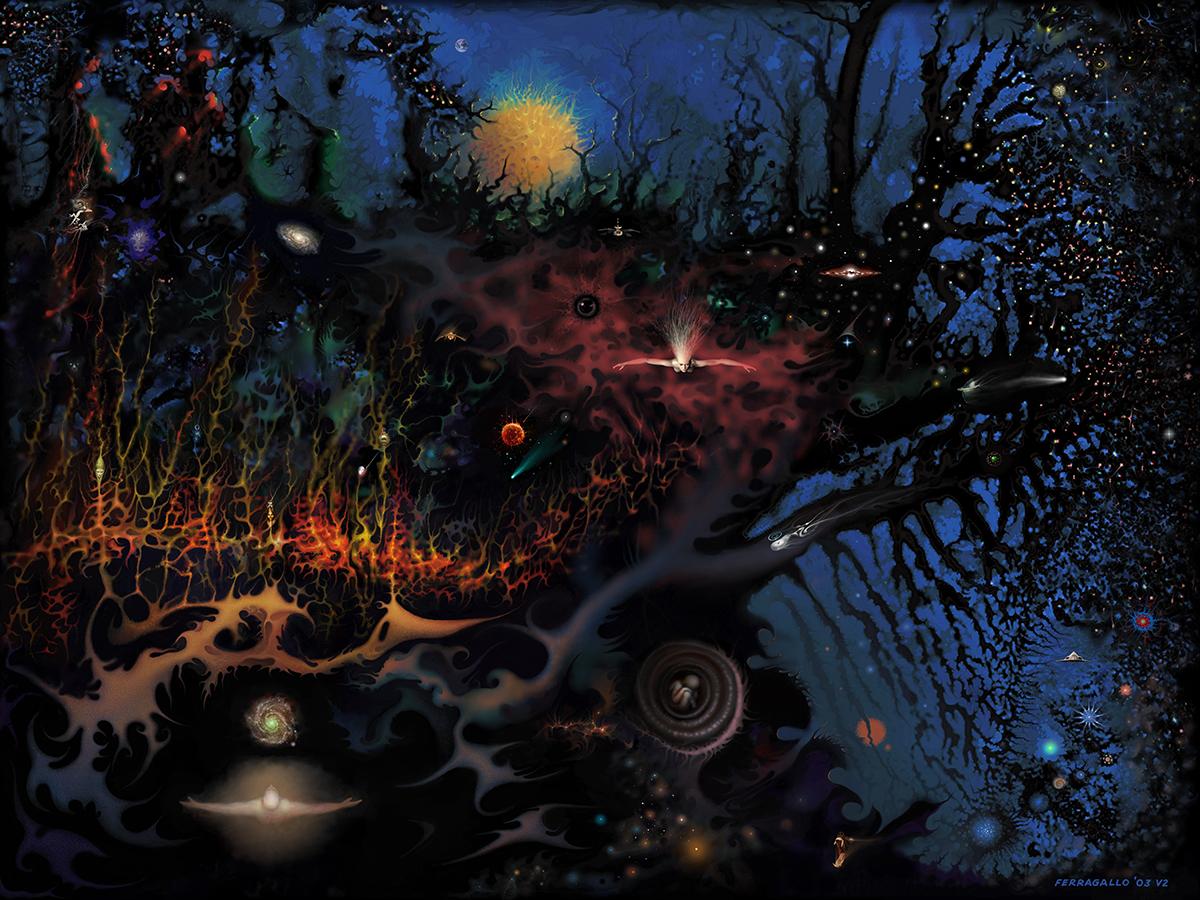
The Cosmic Tree of Life, Roger Ferragallo, Model 1, Version 5, August 8, 2003.
The CTOL painting, Model 1, begun in 2002, remained thematically largely unchanged from its 1994 Synaptic Fire… origin. I however worked its spatial cosmic avenues and byways with high resolution pixel and image additives for more than a year. I plowed its mysterious elements with emergent augmentation: undulating forms became luminous high resolution cosmic plasmas with pregnant gamma ray galactic dust clouds showering elements and organic molecules into the depths of interstellar space. The skeletal tree imagery of branching cosmic tendrils personifies spatial fractal patterns, structures and similitude at all scales committed to life, creativity, and the quantum ‘wildness’ of an enigmatic colossus cosmos.
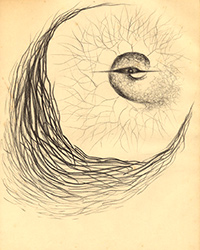
In this vein, I introduced a mystic dual flight metaphor, originally founded in 1953, that continues to populate most of my cosmic paintings. Two ‘bodies’ appear in cosmic co-flight as if a binary pair in some mystical dance of flight and motion. Here, one views the edge on view of a mysterious galactic nucleus core with outstretched helical stardust wings in flight, entangled with the mighty galactic cluster to find heat and light. In parallel harmony, I evoke humankind in self-similar flight with the core mystery of conscious mind, outspread wings of flesh and blood, to travel the resonant interstellar night, cast in luminal flight.
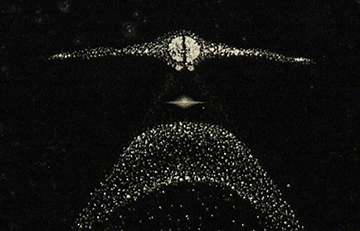
Cosmic Reverie, Detail, Co-flight, Roger Ferragallo, 1953.
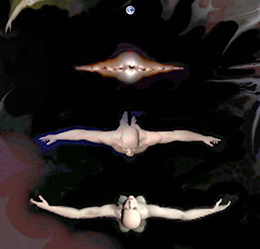
The Universe Knew We Were Coming, Detail, Co-flight the Interstellar Night, Roger Ferragallo, 2001.
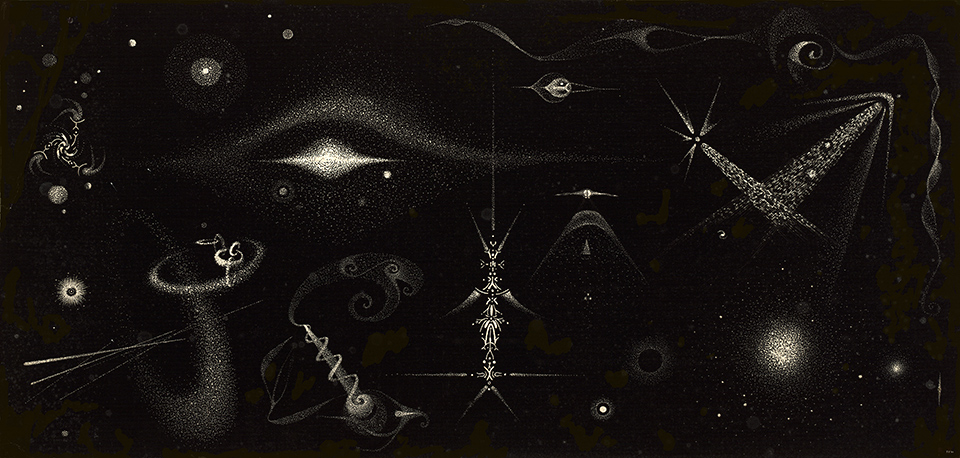
Cosmic Reverie, Ink Resist Scratch, 1953
I began to question and explore within The Cosmic Tree of Life; For what purpose do we, galactic stardust helical beings, entangle with the Final Anthropic Principle that states:
Once the ‘universe’ brings life and intelligence into being, it will continuously evolve and never end.
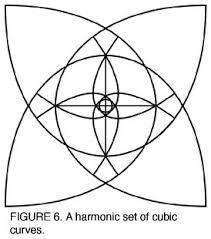
Life endures an end. The anthropic metaphors that appear in all my cosmic works entrain the beauty of symmetry and principal of least action in interstellar co-flight, the spread of boundless stellar wings as mystery and melody.
Harmonic Set of Cubic Curves
Galactic Eye, Sketchbook, 1953.
Of Mind, Flight and Space, Charcoal in Sketchbook, 1958.
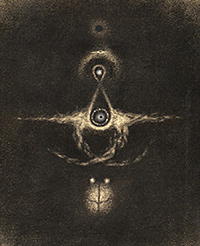
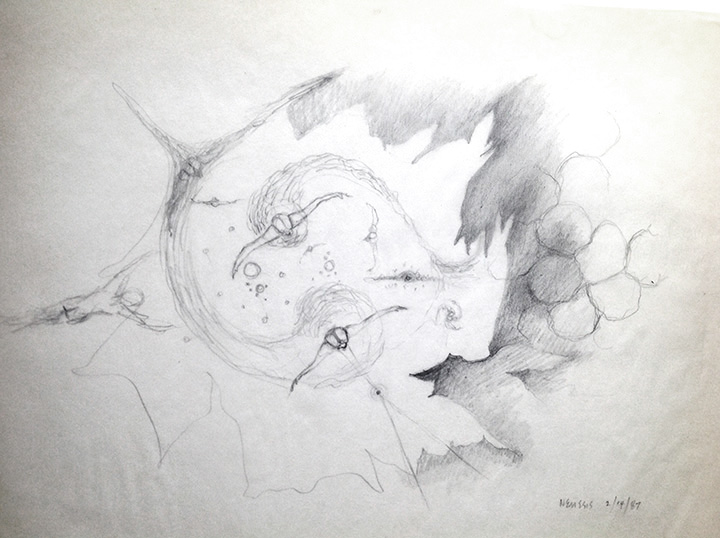
Nemesis Flight, Sketchbook, 1957.
Model 2: The Cosmic Tree of Life (CTOL)
Large screen liquid crystal and plasma displays were coming into the marketplace at a fast rate in 2004, some larger than 72 inches. As a consequence, I adopted their universal ratio of 16⁄9, anticipating the exhibition of the Cosmic Tree of Life on wide plasma screens. Thus, I enlarged the painting to add additional left and right portal space to adjust for this widescreen ratio. It was to be a momentous decision because the conception of the painting evolved and changed at the same time.
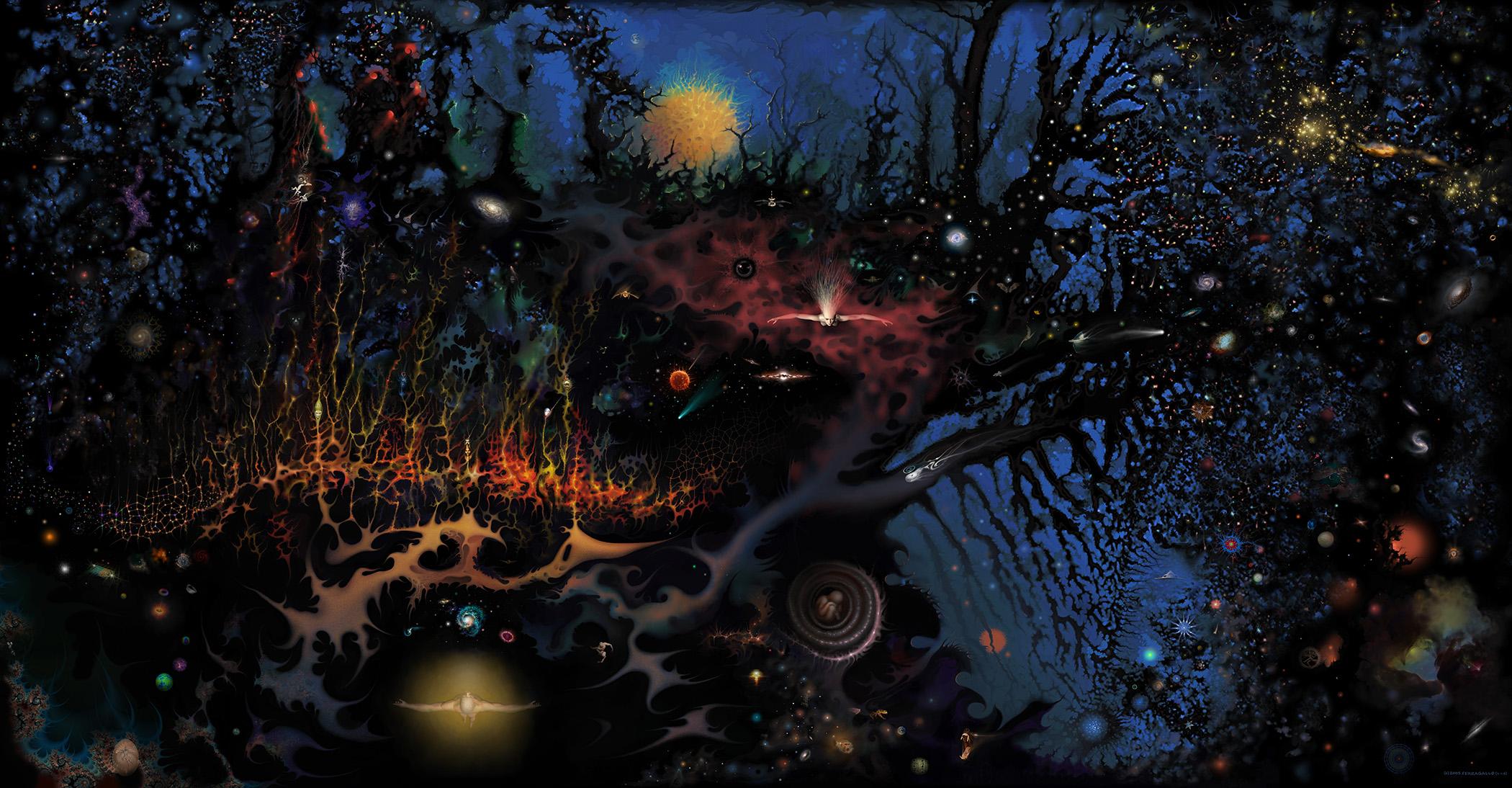
Cosmic Tree of Life, Roger Ferragallo, Model 2, Version 1, Wide Screen Extended to 16×9 Ratio, 2004.
The extension to 16⁄9 ratio was added in October 2004. As a result, the painting would go on to grow in scale, size, pixel resolution, and by 2005, measured 23,600 × 11,248 pixels. Enlarging the work led me to adopt new science and other add-on cosmic enhancement and novelty. When I first conceived the Tree of Life, I thought of it as a work I would complete within four years, but this modification caused me to regard the painting as a work in progress that could extend in time as a continuum!
Since when, I mused, must a dynamic additive digital painting end; particularly a work of scale that anticipated new science, invention, and discovery? The digital medium I was employing contained, within itself, unanticipated cause to regard my painting as a digital mural founded on what common software had already discovered—that software, just as websites, can exist as a dynamic living and evolving unit. The Tree of Life painting, by virtue of this extraordinary electronic channel, came to live in my mind as a continuum. I saw clearly the medium itself allows the creator to decide when the work is done because he simply can! I began to see the Cosmic Tree of Life as an ‘additive’ work that would continue living and growing with time.
An email to Niffer Desmond, and my niece Caitlyn Meeks Ferragallo, marks the moment this new aesthetic took hold.
- Roger Ferragallo
- Niffer Desmond, Caitlyn Meeks Ferragallo
- November 2004
-
Dear Niffer and Caitlyn,
I haven’t finished the painting yet…enlarging the painting’s 3/4 aspect ratio to 16/9 has sent me off wandering into left/right portals of new mystery and content. It will be many more months before I can say the work will be presentable. I’m beginning to realize that painting, as it exists for artists who understand the novel nature of digital creation, is by its very disposition not ever finished. If I had another life to live I would probably start another painting that would require (by current realities) the better part of my anticipated lifespan. It appears that The Tree of Life had its birth a dozen years ago and I’m only now waking up to this reality. It’s an artistic process whereby digital creation lives in the ‘now’ in a new and novel form. It’s no accident I’m beginning to view The Tree of Life as an additive continuum!
Roger
Model 3: Cosmic Tree of Life (CTOL)
At the time, in the midst of an ongoing Cosmic Tree of Life painting, I looked to the mortal edge of being relative to the arrow of time in serial conscious moments that run their course. At the start, there was no certainty regarding the painting’s size or scale, nor did I have a clear view of where it would lead. I felt only the inner necessity to enlarge my vision towards a more inclusive cosmic work beyond and including the anthropic concept.
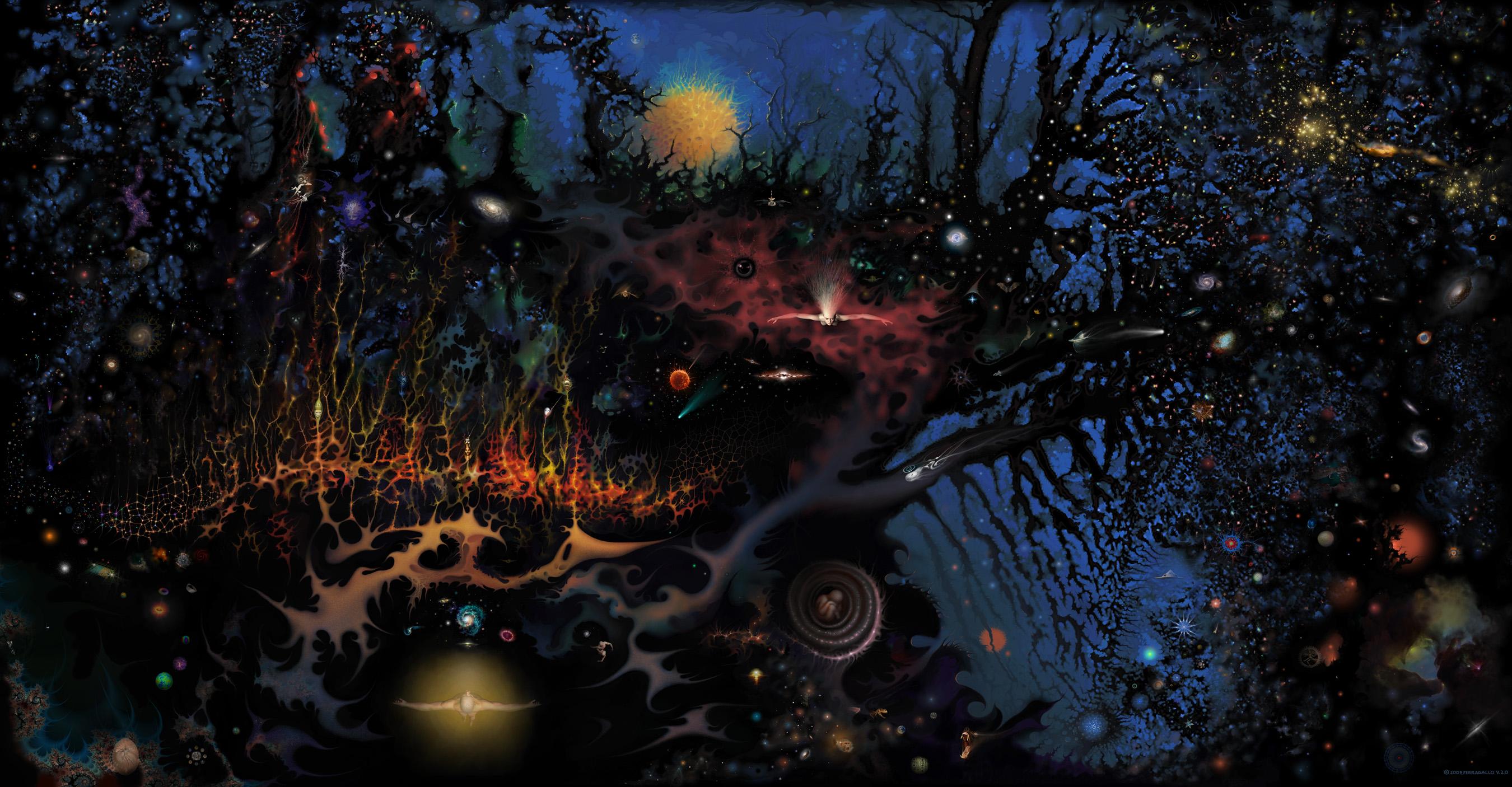
Cosmic Tree of Life, Roger Ferragallo, Model 3, Version 1.5, 2005.
The Universe Knew We Were Coming Exhibited on Princeton’s 18′ × 9′ Display, 2004
With the Tree of Life mural well underway, the Ferragallo web presence led to an unanticipated surprise! Princeton University Computer Laboratory took an interest in the completed The Universe Knew We Were Coming painting.
- Grant Wallace
- Roger Ferragallo
- August 31, 2004
-
Hi Roger,
Sorry not to get back to you earlier. Yes I looked at your website and at “The Universe Knew We Were Coming,” very cool. I wasn’t able to download the high res version, but if you send me a link, I can try downloading and viewing it on our display wall. We have a display wall here made from seamlessly tiling 24 projectors together, this gives 18 million pixels of resolution and is about 18′ long.
Grant Wallace
Staff Director, Princeton Computer Lab Research, University Computer Laboratory
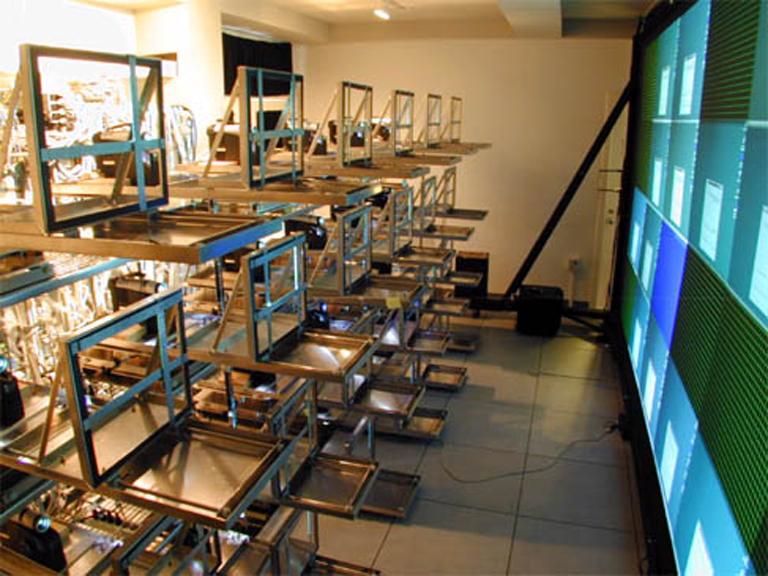
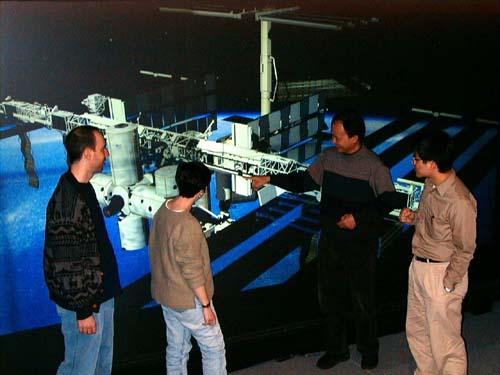
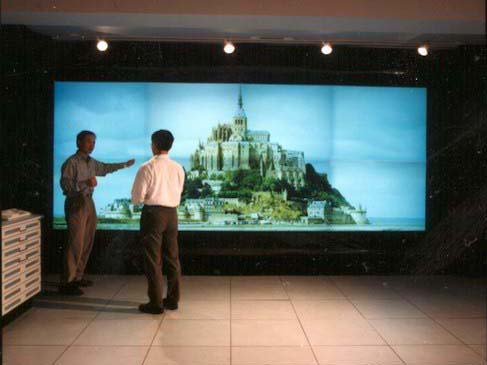
Courtesy of Princeton Computer Science Program, 2004.
The display wall comprised 24 Compaq MP1800 projectors tied together to create an image resolution of 6000 × 3000 pixels on a 8′ × 18′ rear projection screen. The display system used a cluster of PCs with 3D graphics accelerators networked by Myrinet and 100Mb Ethernet. It was equipped with 16 speakers in the display wall room (20′ by 30′) for spatialized sound effects driven by a sound server that used multiple channel sound hardware. The architecture leveraged fast communication mechanisms developed in the SHRIMP project. The wall screen research was sponsored in part by the Department of Energy, Intel, and the National Science Foundation. The display, created in 1998, served the Princeton Computer Science program, breaking new ground in large-scale computer displays, immersive systems, and remote data visualization.
- Grant Wallace
- Roger Ferragallo
- September 3, 2004
-
Dear Roger,
Yes, your new image [The Tree of Life] underway is 169 MegaPixels. It’s interesting to note that the low end estimates of human visual acuity are about 200 MegaPixels (that’s assuming 20:20 vision in normal room light allowing to distinguish objects separated by about 50 arc seconds). So your digital painting resolution is approaching human visual acuity.
In other words, if we had a display that could show your work in native resolution, and we stood at a distance such that your painting occupied our entire visual frame, we would not be able to distinguish individual pixels. This is the holy grail for hi-res displays—once displays surpass human acuity, adding more resolution will not improve what people see.
Higher end estimates for visual acuity are 1.3 GigaPixel, that’s when you allow for higher light contrast, color, motion, and 3D. For instance, stars and glints from highly reflective surfaces are resolvable down to 20 arc seconds or less.
I’ll try to send you display interface and technology links as I find them.
Grant Wallace
Staff Director, Princeton Computer Lab Research, University Computer Laboratory
- Grant Wallace
- Roger Ferragallo
- October 10, 2004
-
Here are images of “The Universe Knew…” on the display wall. We are running with only 15 projectors for some time now due to projector failures (they are almost 5 years old now and many have failed). It is hard to convey with a picture but “The Universe....” looks really good on the display wall, especially with the lights off. Taking a picture of the display wall is problematic because you can’t use a flash—thus need longer exposure, and without a tripod it can be tricky. I will show “The Universe…” to visitors and incorporate it into the formal exhibition, October 14, 2004.
Grant Wallace
Staff Director, Princeton Computer Lab Research, University Computer Laboratory
Exhibition Announcement
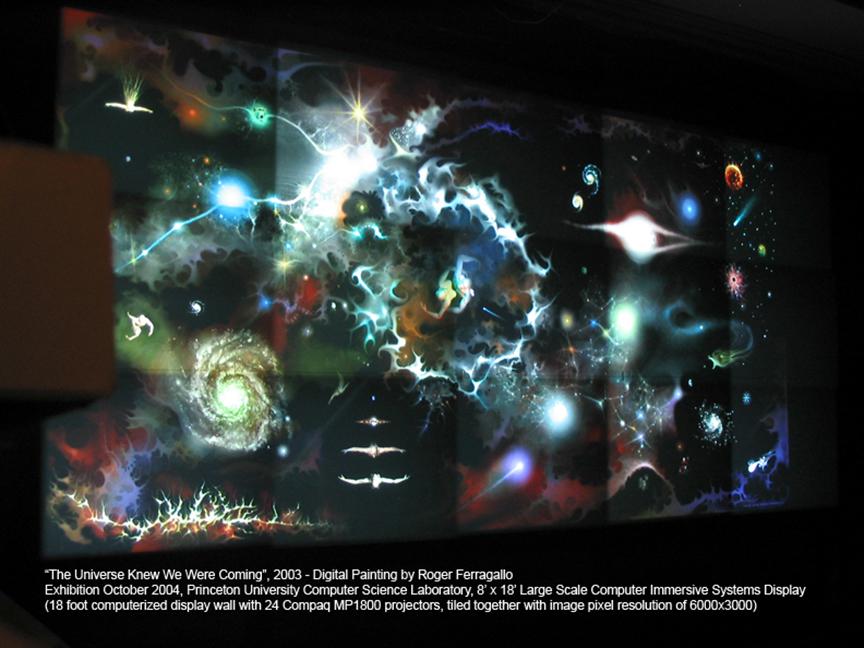
Princeton University Computer Laboratory: This showing of The Universe Knew We Were Coming was facilitated by Princeton Computer Lab Research Staff Director, Grant Wallace. The painting was put on display on October 14, 2004 and can be seen at the Princeton Computer Sciences Laboratory. Roger Ferragallo’s “The Universe Knew…” painting utilizes a powerful software program developed for painters and graphic artists — QFX v8, Ron Scott, Inc.
Early Tree of Life Gallery Proposal, 2002–03
The Princeton display of The Universe Knew We Were Coming was decidedly a game changer in 2004, opening new and old ideas that enlivened my outlook concerning the Tree of Life painting. Emissive luminal electronic displays continued to be central to the philosophy behind the ongoing Tree of Life work. I looked upon native ‘light’ screens as evermore imperative and organic to the digital medium. In 2002, my long-term conception was to invite gallery viewers to interact with the Tree of Life painting by utilizing a hand held device that would allow one to individually circum-zoom around the high resolution work to explore its cosmic imagery within the depths of macro-micro space. The Gallery dream at the time was not feasible and still awaits tools and technology that lie in the future.
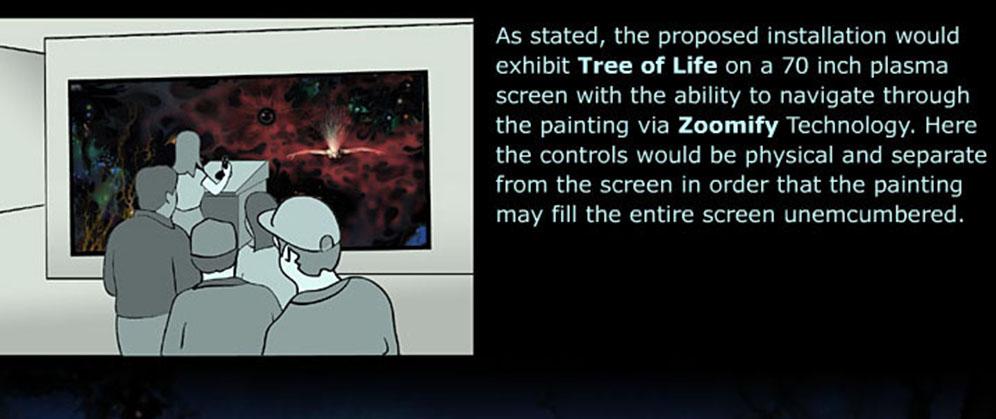
Gallery Interactive Proposal with 72″ Plasma Screen
Tree of Life on Compact Disk, Zoomify Software, 2005
Tree of Life, CD Production, 2005.
In 2005, webmaster Niffer Desmond, and VR technologist Caitlyn Meeks Ferragallo, wrapped their heads around producing a compact disk featuring interactive controls for the ongoing Tree of Life painting. Niffer and I began a negotiation with Zoomify Inc. president David Urbanic, who enthusiastically embraced the interactive Tree of Life project. Zoomify offered outstanding tools that facilitated deep panning and zooming in real-time. Mr. Urbanic graciously went out of his way to modify his unique software to suit the task of interaction.
The interactive CD included a music sound track (Time Suspension by Cosmic Dreamer) created by my niece Caitlyn who resided in Germany. The CD was released in June 2005 to gather support for the nascent developing digital art interactive medium as I conceived it relative to the Cosmic Tree of Life painting. With Niffer’s aid in designing the interactivity and packaging, the CD was successfully produced in San Francisco. It was also a work that looked with an eye to the plasma screens appearing in the marketplace.
CTOL on the Huge 23′ × 9′ HIPerWall at U.C. Irvine
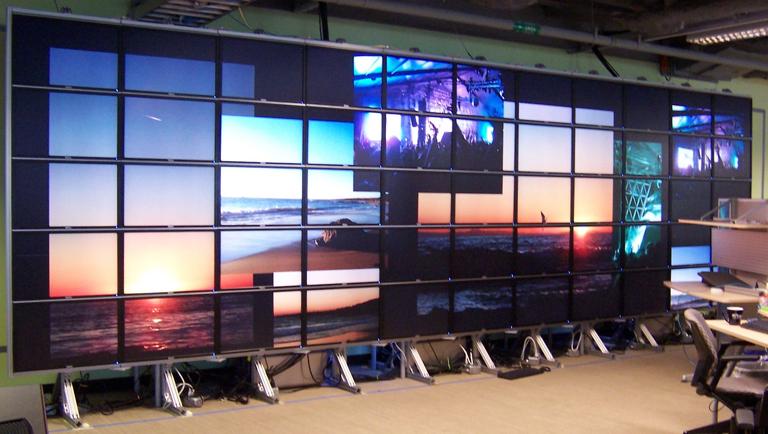
U.C. Irvine’s 23′ × 9′ HIPerWall, a 200 Megapixel Screen Display, 2005
On the heels of the exciting Princeton Exhibition, I received an email from my San Francisco friend and advocate, Christopher Werby. He came across an announcement about a digital display screen—the largest in the world—that stunned me.
- Christopher Werby
- Roger Ferragallo
- October 29, 2005
- Article: GRAVITY Research: HIPerWall
-
This thing—particularly the unit that consists of 50 flat panel displays—looks big enough to display your piece at full resolution all at once.
Christopher
HIPerWall Aug. 8, 2005 Announcement from University of CA Irvine: Scientists at U.C. Irvine have completed the world’s highest-resolution grid-based display for visualizing and manipulating massive data sets. The Highly Interactive Parallelized Display Wall (HIPerWall) is a room-sized display that measures nearly 23′ × 9′. The HIPerWall system, consisting of 50 flat-panel tiles, resides in the Calit2 Center of GRAVITY (Graphics, Visualization and Imaging Technology) at UCI, and provides a total resolution of 200 million pixels, bringing to life terabyte-sized data sets. HIPerWall’s resolution is nearly twice that of the world’s next-highest resolution (scalable) display wall. The resolution of state-of-the-art high-definition television is equal to one-half of one HIPerWall tile,” said Falco Kuester, assistant professor of electrical engineering and computer science, and one of the systems designers. Original article.
Thanks to Christopher, I wasted little time contacting Falco Kuester!
- Roger Ferragallo
- Dr. Falco Kuester
- November 2, 2005, 6:16 PM
-
Dear Dr. Kuester,
I’m a digital painter who has developed a digital work, “Tree of Life” [Ver. 1.0] measuring 23,600 pixels × 11,248 pixels × 300 dpi. Upon learning that the HIPerWall system at U.C. Irvine has the capability of displaying 200 megapixels as a single full-screen visual, I felt it timely to contact you. I understand the very important scientific nature of HIPerWall and its priority to many scientific fields, but I’m suggesting a fine art synergy to possibly display a work of art that, from its inception, was foreseen at the scale of the HIPerWall display. I’m excited by this prospect.
Respectfully, Roger
- Falco Kuester
- Roger Ferragallo
- November 3, 2005
-
Wonderful idea, We have done some work with Max Lions and the GigaPixel photography project (GigaPan) and digital art would be another attractive data source for display HIPerWall. How do we make this happen?
Falco Kuester
Assistant professor of Electrical Engineering and Computer Science
University of California at Irvine
- Roger Ferragallo
- Niffer Desmond, Caitlyn Meeks Ferragallo
- November 14, 2005
-
Sent a 1.6 gig DVD data disk to Falco today. He requested this massive file because of a “powers of ten” utility that works with the display wall. Hard to believe that the Tree of Life will spread out to a 23 foot display at 190 megapixels, especially after painting and zooming into a 21 inch monitor for over 4 years!
Roger
- Falko Kuester
- Roger Ferragallo
- Sunday, December 04, 2005 3:13 PM
- Re: HIPerWall
-
Hello Roger,
The 200 megapixel image looks quite intriguing.
At the same time, HIPerWall illustrates that the resolution should be quite a bit higher to avoid blocky artifacts.....looking forward to your gigapixel+ addition :-). Have attached four images. Hope your account can handle this.
Cheers, Falko
Falco Kuester
Assistant professor of Electrical Engineering and Computer Science
University of California at Irvine
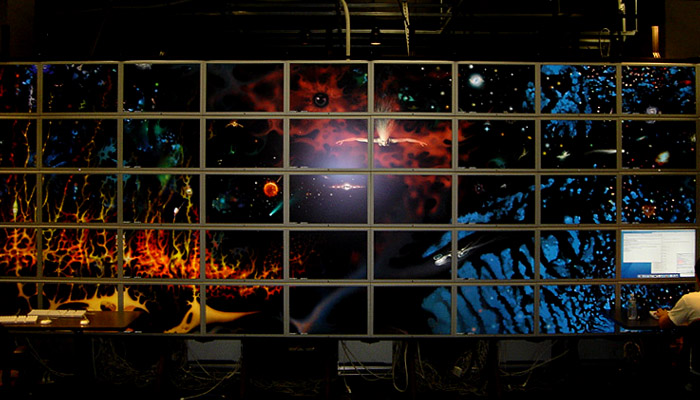
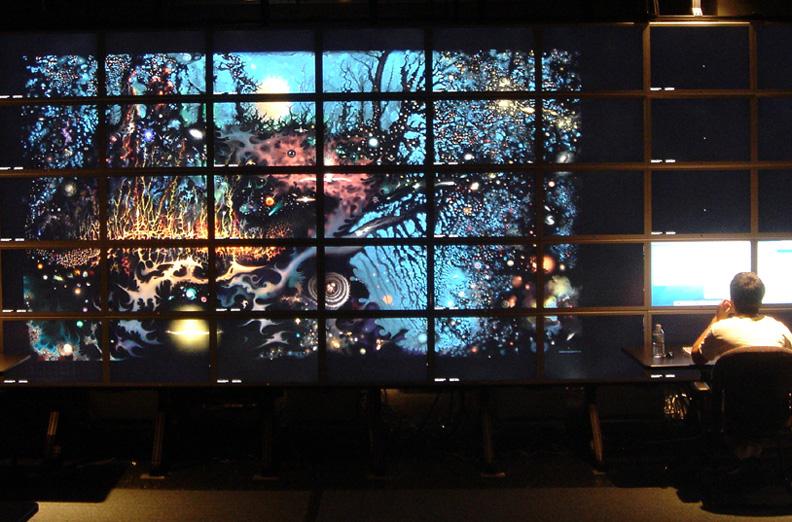
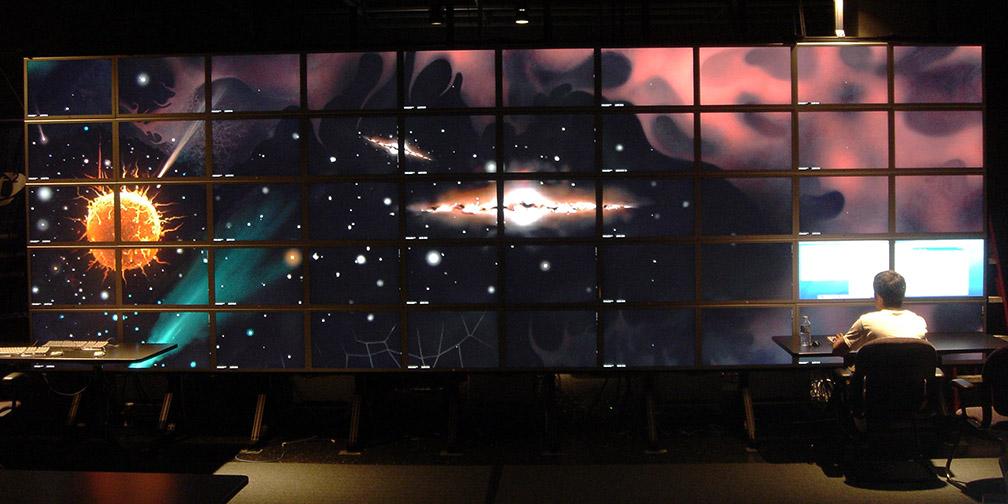 Cosmic Tree of Life, v2.0,
Displayed on U.C. Irvine’s HIPerWall, a
23′ × 9′
Display,
December 04, 2005.
Cosmic Tree of Life, v2.0,
Displayed on U.C. Irvine’s HIPerWall, a
23′ × 9′
Display,
December 04, 2005.
- Roger Ferragallo
- Falco Kuester
- December 04, 2005
-
Hi Falco,
When I got it right and saw the full breadth of the operator at his console with the entire painting spread out, I was stunned! Only then did the power and beauty of HIPerWall sink in! Simply astonishing! I did not realize that you could take so small a detail and enlarge it over the entire 23 foot expanse with the megapixel resolution found on my monitor canvas—breathtaking! And a big “wow” factor for the high quality photographic evidence of the painting as finally resolved in your attachments!
Roger
U.C. Irvine’s HIPerWall Philosophical Reveries and Visions
With HIPerWall, I came to understand that digital imagery— photographic, surreal, metaphoric, and abstract—would one day be arrayed in a medium of pure light to substrates without limits on scale or size. The HIPerWall screen gave heart to my unwavering dream of painting with pure photonic light on screens suffused in brilliant plasmas with hues true to the native emissive photonic light in which it was created! The U.C. Irvine screen represented the actuality of arraying groups of interlocked computer-driven emissive luminal display tiles to achieve the grandeur of emissive light and high resolution scale. My computer system, which I had never regarded as anything but a ‘light generator in a box’ when it appeared in 1982, gave rise to cosmic visions that now soared with the onset of large display screens in 2004–05.
I began to view future screens as vast staging arenas for photonic cosmic visions. I could now foresee symphonic, poetic, art/sci murals that could be displayed to one day rival the Cro-Magnon murals at Lascaux, the Sistine Chapel ceiling, the great baroque cathedral domes, modern day stadia extravaganzas, and one day, to be written to the greatest screen of all, the sky! I had become acutely conscious of the digitally driven aesthetic of ‘scalar micro-macro fractal space’ where one envisions a distant forest and, with the wave of a hand, virtually plummet viewers into the virtual branch of a tree to reveal—full screen—a scintillating colored wing of a tiny butterfly, or with equal ease, zoom from a cosmic landscape to the image of a tiny helical sea shell to reveal the breathtaking self-similar coil of the Andromeda spiral galaxy in all its metaphoric mystery and majesty. Indeed, the new millennium brought a breakthrough in screen plasma technology to rival the computer digital revolution that exploded into view with global exponential tempo. Within a period of less than twenty-five years, the birth of the digital medium and display concepts and screens would come as an avalanche!
In 2004, the large work The Universe Knew We Were Coming appeared at Princeton on their 18′ display wall. This was followed by two unanticipated Southern California Universities (UCI and UCSD) in 2005–06 who had created the largest digital light display screens in the world. For me, it was the synchronistic culmination of an aesthetic dream that came to rest with the ongoing Cosmic Tree of Life. If that were not enough, in 2006 GigaPan, a global dynamic zoom panorama image system, appeared as a total surprise. GigaPan was the child of the digital age that fit all the visual parameters I envisioned for The Cosmic Tree of Life mural.
GigaPan Unexpected New Venue Appears
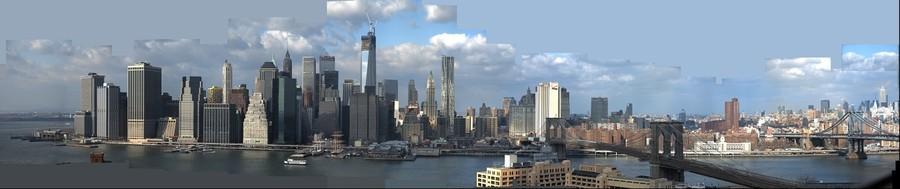
The GigaPan Global Connection Project Mission: to encourage global citizenship and understanding by connecting people, places, and events through the utilization, exploration, and sharing of dynamically viewable high resolution photographic panoramas.
GigaPan was a project initially developed in 2007 by Carnegie Mellon University with partners Google Earth, NASA Ames Research, and National Geographic. This amazing digital global system was designed to exclusively exhibit megapixel photographic high resolution panoramas from photographers throughout the world. It has easy-to-use software with a tool set that allows viewers to dynamically circum-zoom complex high resolution photographic panoramas and landscapes, and is able to fill a computer screen with a single far off object like a sparrow on the limb of a tree, or a single human face out of a crowd of thousands. I found GigaPan remarkably suited to exhibit the CTOL digital painting because it exceeded and fit all of my technical and display parameters.
Cosmic Tree of Life on the Worldwide GigaPan Cloud
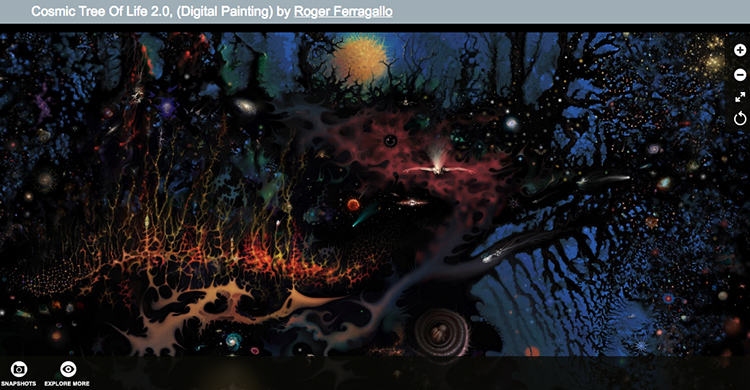
The Cosmic Tree of Life, v2.0–3.0, Displayed on GigaPan, 2007.
Serendipity played a most extraordinary prescient hand when GigaPan appeared in 2007. On discovery, I immediately deemed GigaPan a global gallery without walls fit to the reality of the digital revolution! It was a stunning technological development I could never have imagined in 1984, when with stylus in hand, I began to paint with light. Indeed, I excitedly deemed it a visionary venue made to order for my interactive zoomable high resolution cosmic masterwork. The CTOL mural could now live in the digital cloud, open to a web connected world, available day and night, seven days a week, to a global audience! It was totally unexpected! Here was a venue made for my cosmic mural to be viewed in a medium of light with a dynamic tool set that encouraged interaction and connection to reach the global commons.
- Illah Nourbakhsh
- Roger Ferragallo
- Friday, September 28, 2007 9:40 PM
- Re: Digital Painting, HIPerWall and Global Connection…
-
Roger, your work is inspiring and it is a pleasure to meet you.
I have a question that immediately comes to mind. We host many images that have 240 megapixels and up—even several gigapixels. If you can save your entire painting in TIFF mode, you can choose to use the uploader that we have available on the GigaPan website front page (after you create a free login account and actually log in) to upload the entire digital painting to GigaPan.org. If you do that, then you and others can zoom into and around the full resolution details.
I realize as an artist you may not want this image available in such a format—but it would be such a fantastic addition to our demonstration of what is possible on GigaPan.org.
Do look at our terms of service—you would of course retain copyright and all such protections. Since we don’t have any save or print functionality, users would have a very hard time getting full resolution off the site onto their hard drives (unless they’re very serious hackers).
Anyway, your decision, but I just want to encourage you to consider uploading your image—it would make our week...
best,
Illah Nourbakhsh
GigaPan
- Illah Nourbakhsh
- Roger Ferragallo, Randy Sargent
- Wednesday, October 17, 2007 6:40 AM
- Re: Digital Painting, HIPerWall and Global Connection…
-
Dear Roger,
I hope you’ve been enjoying the attention! I think your picture has been viewed nearly 1,000 times! Congratulations.
At some point we’ll want to start to actively pursue the arts in connection with GigaPan more directly. I’d love to have your advice and participation in that process, if that’s interesting for you?
best,
Illah Nourbakhsh
GigaPan
- Roger Ferragallo
- Illah Nourbakhsh
- Wednesday, October 17, 2007 9:52 AM
- Re: Digital Painting, HIPerWall and Global Connection…
-
Hi Illah,
Yes, I’ve been thrilled with the attention the painting has engendered.
I’m delighted to hear you speak of pursuing the arts in connection with GigaPan. This would be a natural evolution to pursue and, yes, I will enjoy working with you because it also touches a special nerve that embraces my career as an art educator.
I continue to be floored by GigaPan’s “snapshot” tool. What an amazing thrill it is to take a virtual auto-flight with GigaPan snapshot tools to suddenly arrive, full screen, to view a beautiful butterfly! This is exactly what I had in mind during the years I worked on the painting because the unique creative process inherent in the digital medium that facilitates zooming and panning—all within the confines of a 21 inch cathode ray monitor to conceive an expressive work of art. One that accessed by a global audience (today on mobile phones) the aesthetic of dynamic interaction to close the aesthetic distance between the work of art and viewer. This suited my cosmic subject matter and for me was a eureka moment!
By all means let us work together.
Roger
GigaPan was brilliantly conceived with easy-to-use software tools, permitting viewers to personally frame images and take snap shots at all zoom levels, and enabling direct text communication and interaction with the artist. What a gift to painters! This again speaks to my clarion call to closing aesthetic distance between artist and spectator. GigaPan Snapshots also allow viewers to click on a stable cumulative library of dynamic “snapshots” that render a rather extraordinary dynamic zoom ride into the vast depths of the CTOL 30 foot digital mural to view, full screen, an object of interest such as a galaxy or seashell. Within a year, CTOL was a huge success on the GigaPan site with over 72,000 hits. GigaPan is no longer driven by its early pioneers, but it continues to this day to thrive with outstanding private new ownership and tools intact.
Singapore: International Symposium on
Electronic Art
Cosmic Tree of Life 2.0
Exhibited at ISEA2008
July 24–31, 2008
I was invited to Singapore by the International Symposium on Electronic Art (ISEA) to give a live, interactive presentation of The Cosmic Tree of Life digital mural. My presentation was given at the Management University School of Economics and Social Sciences and National Museum of Singapore. It was given in an auditorium that furnished me with a large computer projection screen wirelessly connected to a laptop computer with an online link to the internet. This facilitated online, real-time access to the global GigaPan site, live, in front of an appreciative Singapore audience. I was thus able to demonstrate and interact with my 546 million pixel Tree of Life mural in real-time in front of a live audience. It was a successful interactive demonstration that included audience participation.
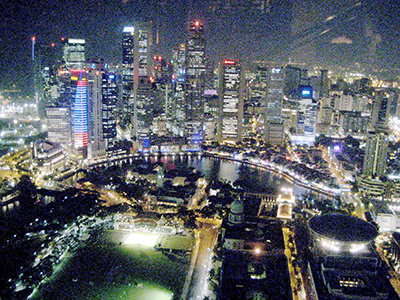
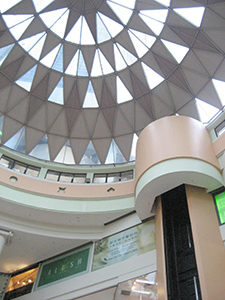
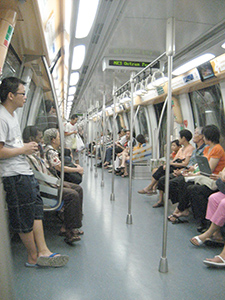
Singapore—a great city, July 27 2008.
CTOL Finds HIPerSpace, the Largest Screen in the World, 31.8′ × 7.5′, at U.C. San Diego, 2007–09
On the heels of the Princeton Screen, U.C. Irvine’s HIPerWall, and the Singapore exhibition, the mother of all screens surfaced at U.C. San Diego in 2007 with the massive HIPerSpace Screen, a multi-tiled 31.8′ × 7.5′, 286,720,000 million pixels display. With over 1⁄4 billion pixels, the HIPerSpace display was the largest in the world!
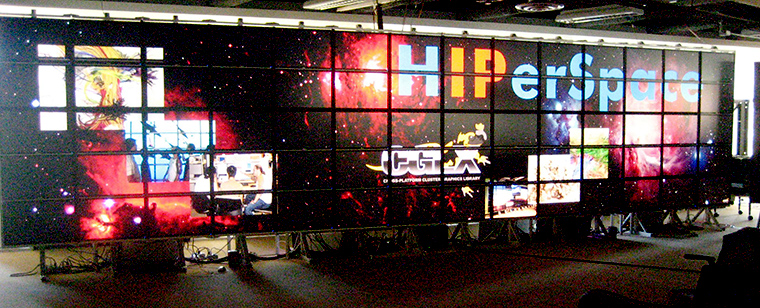
HIPerSpace, a Multi-tiled 31.8′ × 7.5′, 286 Megapixel Screen, 2007.
Having met Director Falco Kuester online in 2005, regarding displaying the Tree of Life mural on the HIPerWall at the U.C. Irvine campus, I came to understand that U.C. Irvine (UCI) and U.C. San Diego (UCSD) were located within a hundred miles of each other with connected engineering departments that worked in close harmony with each other. Professor Kuester was the architect of the HIPerWall’s 200 megapixel display wall which remained at UCI. When Kuester and his group moved from the Irvine campus to UCSD in 2006, they began to work on the next generation massively tiled display wall: HIPerSpace.
From HIPerWall at the start, the HIPerSpace Kuester display wall, within a handful of years, rose to 315,648,000 million pixels. The later HIPerVerse wall boasted 507,904,000 million pixels. At the time, these were the highest resolution displays in the world.
The combination—known as the Highly Interactive Parallelized Display (HIPerSpace 31.8 × 7.5 feet)—could thus deliver real-time graphics simultaneously across 420 million pixels to audiences in Irvine and San Diego. This capability would allow researchers at both U.C. sites to collaborate more intensively with each other, and eventually with other campuses, thanks to the rapid rollout of OptiPortals outside of California. — courtesy of UCI and UCSD.
- Roger Ferragallo
- Falco Kuester
- March 5, 2009, 7:39 PM
- News from Roger Ferragallo
-
Hi Falco,
Sent the CTOL 3.0 version painting to you today via priority mail. You will find improvement in its zoom-in fractal space and resolution.
Looking forward to my visit on March 27th.
Again, my best wishes for the work that goes on with HIPerWall, HIPerSpace, and HIPerVerse! I remain awed with the breadth of these achievements and where they lead in both science and art.
Warmest regards
Roger
- Falco Kuester
- Roger Ferragallo
- Tuesday, March 10, 2009 4:15 PM
- Re: News from Roger Ferragallo
-
Hi Roger,
Just got your CD [Ver. 3.0] and the new image is up on our wall [HIPerSpace].
At first we had a hard time pinpointing the differences [Ver. 2.0 to 3.0] until we noticed that you did indeed preserve dimensions between generations. We have a tera-pixel image viewer that allows blending between image stacks and when combining the old with the new rendition, differences pop right out at you and actually add nicely to the overall impact, i.e. hair blowing in the wind, stars sparkling, objects appearing and disappearing, etc.
Cheers, Falko
Falco Kuester
Assistant professor of Electrical Engineering and Computer Science
University of California at Irvine
Visit to HIPerSpace Screen, 2009
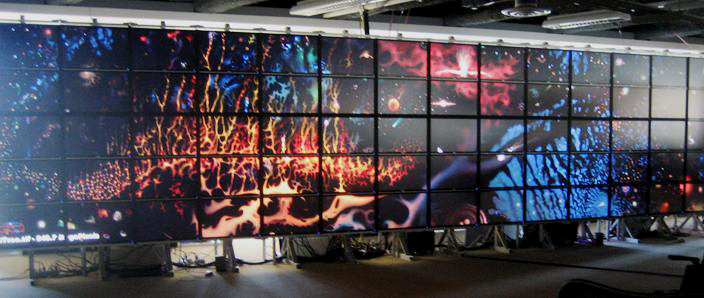
The Cosmic Tree of Life on the HIPerSpace Screen, Photography by Roia Ferrazares.
Immediate shock and joy greeted us on arrival as we viewed the entire Cosmic Tree of Life spread wide in radiant light across 31.8 feet (with a 7.5′ screen height limit). My daughter, Roia Ferrazares, and I arrived at the San Diego Calit 2 Engineering Center on March 27, 2009. Director Falco Kuester and staff graciously reserved the entire day for us to experience the HIPerSpace Display Wall. Even more telling was the remarkable scalable power of the HIPerSpace wall itself.
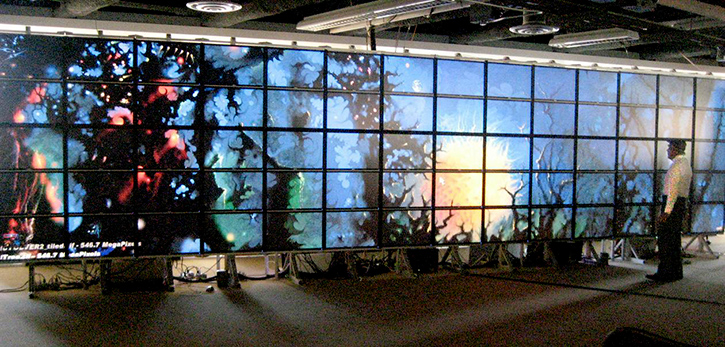
Zoom Depth High Resolution: Cosmic Energy Tendrils in the Wake of a Blazing Star
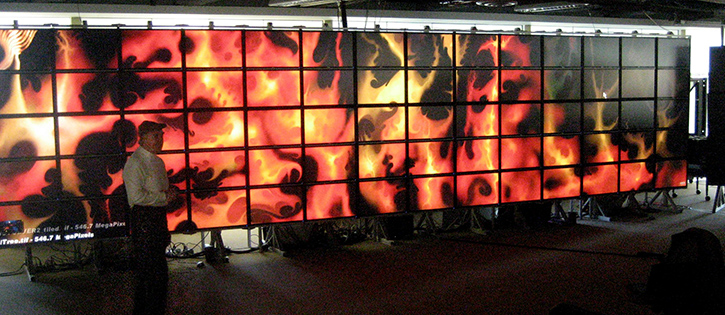
Amid Roiling Flows of Plasma: the Fourth State of Matter
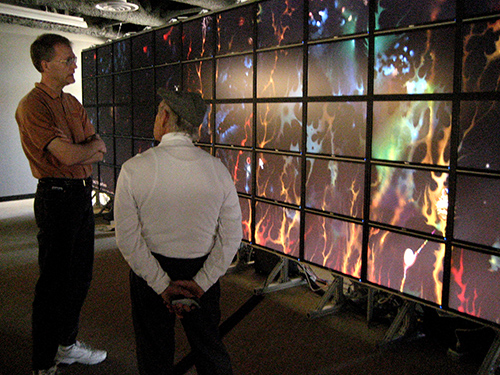
Spread of Red Orange Waveforms Depict the Polymorphous
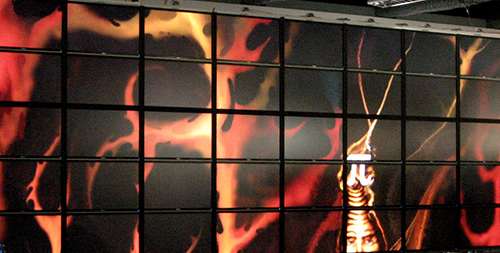
Interstellar Plasmas to the Length and Scale of HIPerSpace
A Note on The Cosmic Tree of Life by Conrad Ranzan, Cosmologist, DSSU Theory
I’ve been thinking about the parallels of our work: We are both trying to understand the universe and present our understanding to those people who have thought seriously about the issues and (not to be exclusive or elitist) to people who just might be inspired to delve deeper.
I take you seriously when you say “version 3.0 will introduce more literal content, ideas, and imagery…CTOL is a philosophical work that combines science, astronomy and cosmology!”
I like your self-challenge: “Now, how do I bring the visual painter to task here?”
Now here is something I cannot over stress. Our universe does not have a beginning and it does not have an end. However, everything in the universe has a beginning and an end. But what is most amazing is that the universe embodies continuous ‘beginning’ and continuous ‘ending.’ What this means is that the symbolism of a “cosmic egg” is not the best. Although it is a popular representation, it is misleading if the purpose is to portray reality. The new representation of perpetual formation and balancing destruction is where the artist will be brought to task! What about the stuff in between?—between vast numbers of quantum beginning events on the one hand and numerous suppression-annihilation events on the other? This is the domain of all evolution. This domain I see represented by your Cosmic Tree of Life. The roots with the hair like tips represent matter formation events. The root network represents the evolution of subatomic particles towards basic matter. The trunk is the transitional link between basic matter and organic matter. The branching pattern traces the evolution of astronomical objects as well as the evolution of all forms of life. The branch or leaf tips ‘connect’ to blackness—a connection that symbolizes the flow of some object, large or small (or, more likely, its ashes), as it is absorbed into some terminal-type black hole (the ones with the SU-AN cores). Now picture this tree growing continually but never becoming bigger! — Conrad Ranzan, Cellular Universe Website
Acknowledgments
-
King McCarthy (Walnut Creek): An entrepreneur in the business of selling MS-DOS PCs, 1982–92; Sold computers and kindly kick-started my digital high tech education as a digital painter. We were close friends and worked together on exciting business ventures involving stereo lenticular imaging (autostereograms). To my gratitude, Microsoft introduced Windows in 1986 to banish the daunting MS-DOS operating system. To this day, Windows has served me well for my cosmic paintings.
-
John Everett Kristoff (Hokah, Minnesota): A superlative craftsman, writer, author, poet, and philosopher devoted to family and his home, built by hand, on his own beautiful farmland and forest acreage in the remote woodland hills of Minnesota. He is a modern day Thoreau who harbors the whole experience of nature. We met with an interest in architectural stereoscopic tiling that led us to a stereoscopic business partnership in the late 1980s and 1990s. John kindly assisted me with recent cosmology sculptural works and I remain grateful for his many reviews. We enjoy a camaraderie that reflects warmly on both our lives and work.
-
Niffer Desmond (Pennsylvania, California): With Caitlyn came her close friend, the brilliant master artist-artisan, founder of Trilodeon, my ferragallo.com webmaster, and spirit savant who opened the doors to global communication. The website you witness is Niffer’s creation. In 2002, ferragallo.com was born. As a result of this, my connection to the world wide web both facilitated and impacted my work. Interactive web designer for the published CD, Tree of Life (2006), the ferragallo.com website continues to develop as an autobiographic document that spans my life and art career.
-
Caitlyn Meeks Ferragallo (Germany, Denmark, San Francisco): Talented VR designer, entrepreneur, and Second Life devotee, artist, designer and technologist, Caitlyn gave important technical assistance and was responsible for my early 1995 web presence. Caitlyn was the co—producer of The Tree Of Life CD, 2005, and the designer of the intro music “Time Suspension” by Cosmic Dreamer, and the producer of the HIPerSpace video of the CTOL mural based upon its live exhibition at U.C. San Diego in 2012. Caitlyn is today settled in San Francisco where she is at High Fidelity Co. Metaverse, VR and Chief Designer at Second Life.
-
David Urbanic (Palo Alto): David is President and CEO of Zoomify, Inc.. Dave was gracious, providing custom software design to facilitate exclusive circum-zoom interaction with the published Tree of Life CD, 2005.
-
Christopher Werby (San Francisco): Christopher is CEO of Pipsqueak Productions, LLC. His broad experience in many fields have been invaluable to me and, above all, he has impacted my work with timely information and advice. His remarkable talent covers a wide range of experience in many fields: master of websites, programming, photography, graphics, writing, branding, design, and law. Christopher’s help and assistance throughout my years of digital work pertaining to The Cosmic Tree of Life mural have been invaluable.